Low-Residency MS in Healthcare Management: Advancing Leadership Pathways for Professionals and Transfer Students
Blog Thumbnail
🔍 SEO Introduction: Why Low-Residency MS in Healthcare Management Programmes Matter
The Master of Science (MS) in Healthcare Management is a graduate-level programme designed to equip professionals with the leadership, operational, and analytical skills needed to navigate the complex healthcare sector. As the healthcare industry faces rapid transformation—driven by policy shifts, technological innovation, and evolving patient needs—there is a growing demand for leaders who can bridge clinical expertise with business acumen.
Low-residency MS in Healthcare Management programmes offer a unique blend of online coursework and periodic on-site sessions. This hybrid format is especially valuable for workforce learners and transfer students already engaged in healthcare roles or seeking to advance their careers without pausing professional commitments. The flexibility, practical focus, and transfer-friendly structure of low-residency programmes make them a strategic choice for those balancing work, study, and career progression.
Understanding the Programme: MS in Healthcare Management
The MS in Healthcare Management prepares learners for leadership and management roles across the healthcare ecosystem—including hospitals, health systems, insurance companies, consulting firms, and public health organizations. The curriculum typically covers:
Healthcare operations and systems management
Financial and strategic decision-making
Health policy, law, and ethics
Quality improvement and patient safety
Healthcare analytics and information systems
Organizational behavior and leadership
Specializations or elective tracks may include healthcare compliance, population health, or innovation management, allowing students to tailor their studies to specific career goals.
Why this discipline matters:
Healthcare management is critical for ensuring that healthcare delivery is efficient, equitable, and sustainable. As the sector faces challenges like rising costs, regulatory complexity, and workforce shortages, skilled managers are essential for driving organizational performance and improving patient outcomes.
The Healthcare Management Industry Landscape
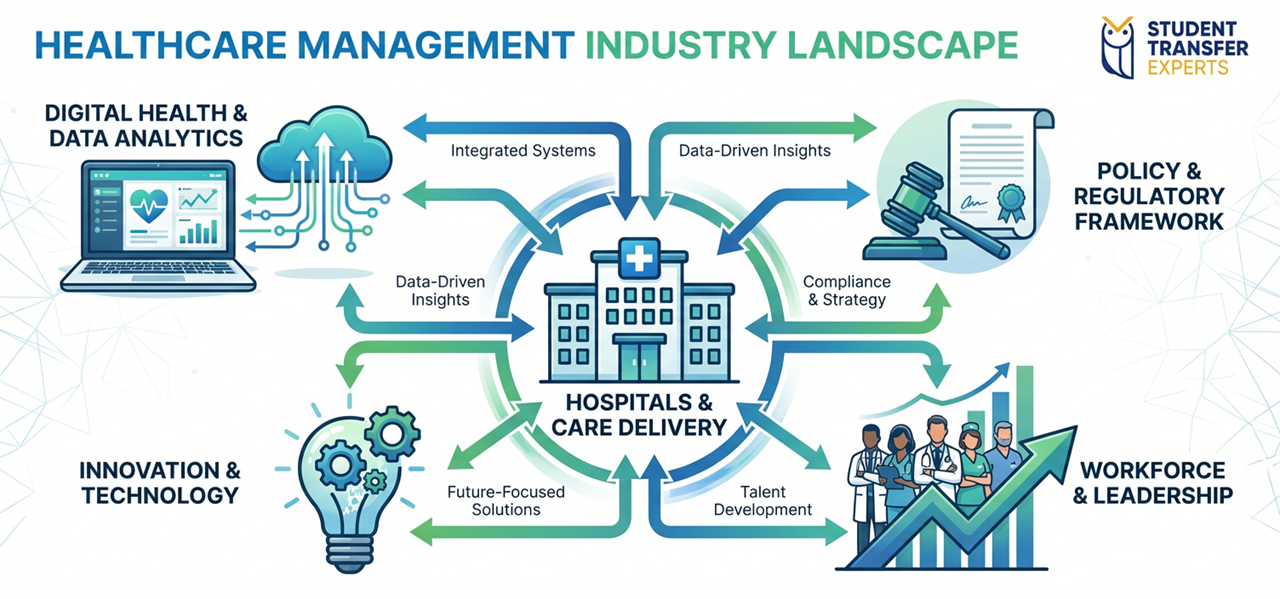
Infographic of Healthcare Management Industry Landsacape
The healthcare management field is dynamic and rapidly evolving. Key trends include:
Digital transformation: Adoption of electronic health records, telehealth, and data analytics is reshaping care delivery and administrative processes.
Policy and regulatory change: Ongoing reforms in healthcare financing, insurance, and compliance require agile leaders who can navigate uncertainty.
Workforce demand: The U.S. Bureau of Labor Statistics projects a 28% growth in medical and health services manager roles from 2021 to 2031, much faster than average.
Innovation and value-based care: Emphasis on quality, patient experience, and cost-effectiveness is driving new models of care and management.
Major employers include hospitals, integrated health systems, insurance providers, consulting firms, government agencies, and non-profit organizations. Professional associations such as the American College of Healthcare Executives (ACHE) and Healthcare Financial Management Association (HFMA) provide networking and credentialing opportunities.
Why Low-Residency Works Especially Well for Healthcare Management
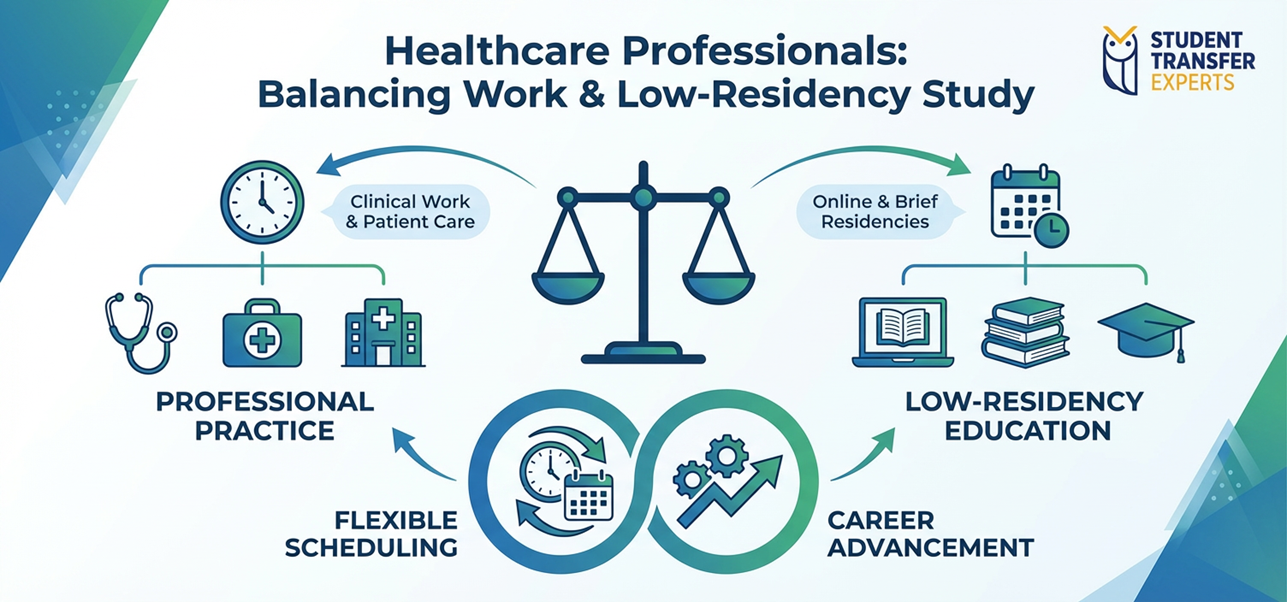
Infographic of Healthcare Professionals: Balancing Work and Low-Residency Study
Low-residency formats are particularly well-suited to healthcare management for several reasons:
Workforce compatibility: Most students are working professionals—nurses, clinicians, administrators—who need to maintain employment while studying.
Applied learning: Periodic on-site residencies enable hands-on workshops, simulations, and networking, which are vital for developing leadership and problem-solving skills.
Flexibility: Online modules allow learners to progress at their own pace, accommodating shift work and family responsibilities.
Professional networking: In-person sessions foster peer connections and mentorship, supporting career advancement and knowledge exchange.
Transfer-friendly: The modular structure and credit recognition policies of many low-residency programmes make them accessible to transfer students seeking to maximize prior learning.
Why this matters:
Healthcare management is a field where real-world experience and professional relationships are as important as academic knowledge. Low-residency programmes bridge the gap between theory and practice, supporting immediate application of learning in the workplace.
Comparison of Flexible Programme Structures
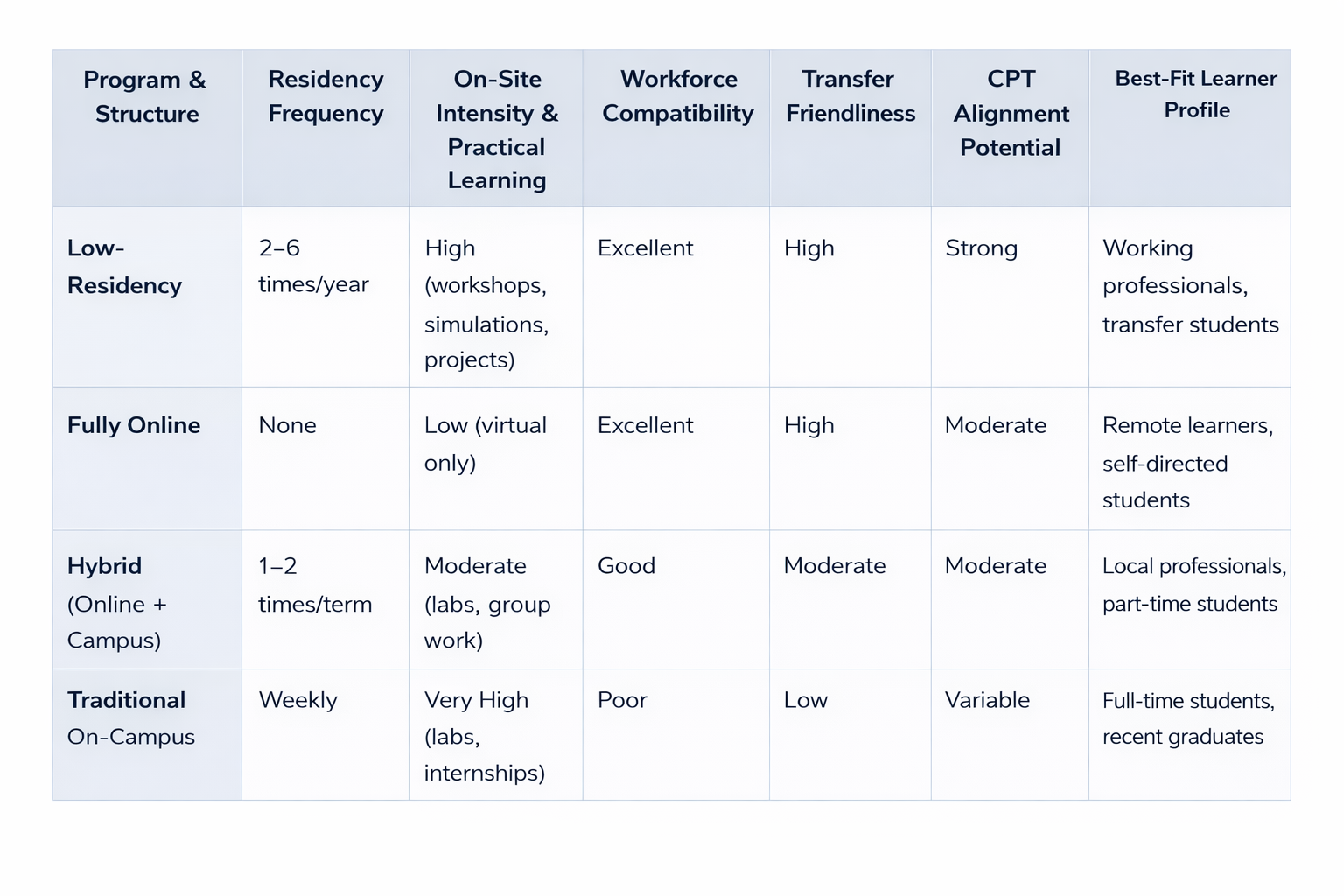
Comparison Table of Flexible Program Structures
Interpretation for Healthcare Management:
Low-residency structures offer the optimal balance for healthcare professionals who need both flexibility and practical, in-person learning. They are also the most transfer-friendly, supporting credit recognition and CPT (Curricular Practical Training) alignment for international students.
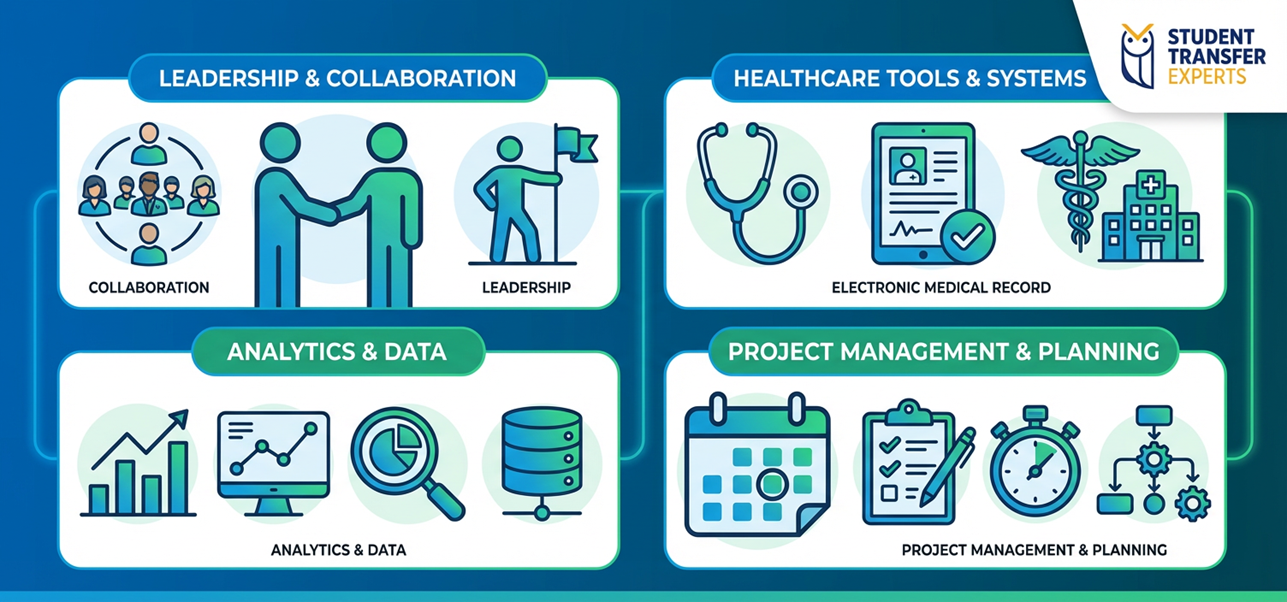
Core competencies developed in a low-residency MS in Healthcare Management include:
Leadership and change management: Guiding teams, driving organizational improvement, and managing transitions.
Financial acumen: Budgeting, cost analysis, and financial decision-making in healthcare settings.
Strategic planning: Developing and implementing strategies aligned with healthcare trends and policy.
Healthcare analytics: Using data to inform decisions, improve quality, and optimize operations.
Quality improvement: Designing and leading initiatives to enhance patient safety and care outcomes.
Healthcare law and ethics: Navigating regulatory frameworks and ethical dilemmas.
Project management: Leading projects from conception to implementation, often in interdisciplinary teams.
Communication: Presenting ideas clearly to diverse stakeholders, from clinicians to executives.
Industry-standard tools and methodologies:
Students gain proficiency in tools such as electronic health records (EHR) systems, healthcare analytics platforms, and project management software, as well as methodologies like Lean, Six Sigma, and evidence-based management.
How Industry Values These Skills
Healthcare employers increasingly seek managers who can:
Lead multidisciplinary teams and drive change in complex environments
Analyze data to improve efficiency, quality, and patient outcomes
Navigate regulatory and compliance requirements
Communicate effectively across clinical and administrative domains
Implement technology and innovation in care delivery
Organizations such as hospitals, health systems, consulting firms, and government agencies value applied, workforce-ready skills over purely theoretical knowledge. Graduates of low-residency MS in Healthcare Management programmes are often considered for roles such as:
Healthcare administrator or manager
Operations director
Quality improvement leader
Healthcare consultant
Policy analyst
Project manager
Applied learning—through residencies, practicums, and real-world projects—ensures graduates are prepared to make an immediate impact.
Value for Transfer Students
Low-residency MS in Healthcare Management programmes offer several advantages for transfer students:
CPT/OPT relevance: Many programmes are structured to support Curricular Practical Training (CPT) and Optional Practical Training (OPT), enabling international students to gain work experience in healthcare management roles while studying.
CGPA and credit transfer flexibility: Our university partners often recognize prior coursework and professional experience, allowing for smoother credit transfer and flexible CGPA requirements.
On-campus residency requirements: Short, intensive residencies provide essential practical learning and networking without requiring long-term relocation.
Cost advantages: Low-residency formats typically reduce living expenses and allow students to continue working, making them more affordable than traditional on-campus programmes.
Visa and immigration process guidance: While not legal advice, our partners offer support navigating the F-1 visa process, CPT/OPT eligibility, and SEVIS compliance.
Who This Programme Is For
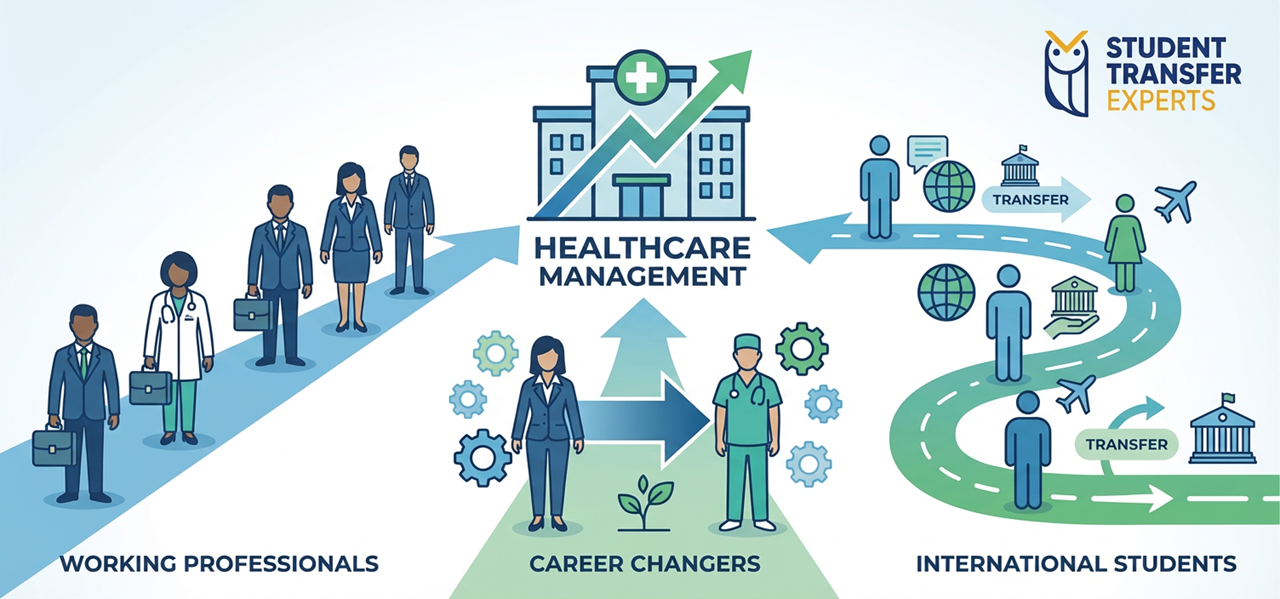
Infographic of Who MS in Healthcare Management Program is for
Best suited for:
Working healthcare professionals (nurses, clinicians, administrators) seeking advancement
Career changers with experience in healthcare or related fields
International students needing CPT/OPT-compatible study options
Transfer students with prior graduate or undergraduate credits in health, business, or management
Professionals seeking leadership roles in hospitals, health systems, consulting, or public health
Take the Next Step
If you're ready to evaluate your academic or professional pathway:Begin your application or evaluation here: https://form.typeform.com/to/HRz41hcQ
If you need clarity on transfers, fresh admissions, STEM pathways, CPT/OPT options, low-residency formats, or career alignment, ask STE GPT your questions first. You can access the STE GPT here: https://gpt.studenttransferexperts.com/
#LowResidencyEducation #TransferStudents #HealthcareManagement #WorkforceLearning #FlexibleEducation #CareerAdvancement #OnlineEducation #HigherEducation #StudentTransferExperts #TransferGPT #HealthcareLeadership #CPT #OPT #HealthcareCareers #STE