How a Low-Residency MS in Organizational Leadership Supports Workforce Learning and Transfer Continuity

Blog Title Image
A low-residency MS in Organizational Leadership sits at the intersection of management, people strategy, workplace culture, and applied change leadership. Unlike a narrowly technical business degree, this programme is built for professionals who want to lead teams, improve systems, navigate organizational change, and strengthen performance across a wide range of sectors. That makes it especially relevant for transfer students and workforce learners already studying or working in the US.
The field itself has become more important as organisations deal with rapid AI adoption, flatter hierarchies, burnout risk, workforce reskilling, and higher expectations around culture and employee experience. Recent leadership research points in the same direction: employers increasingly need leaders who can combine human judgment with AI fluency, lead across functions without relying only on formal authority, and sustain trust during uncertainty. In practical terms, that means organisational leadership is no longer just about supervision. It is about communication, coaching, systems thinking, change management, and execution.
This is also why the low-residency format works so well for this programme type. Organizational leadership is an applied discipline. Learners benefit from flexible online study for theory, strategy, and reflection, but periodic in-person residencies add value through workshops, simulations, networking, group problem-solving, and leadership practice. For working professionals, that structure supports workforce learning without forcing a full break from employment. For transfer students, it can support continuity while preserving academic momentum and making planning around credits, scheduling, and career development more manageable.
Understanding the Programme: MS in Organizational Leadership
An MS in Organizational Leadership prepares learners to lead people and processes more effectively in complex organizations. While programme designs vary, the field usually centers on several core areas:
leadership theory and practice
organizational behavior
change management
conflict resolution
strategic communication
team development
ethics and decision-making
diversity, culture, and employee engagement
project or performance management
What distinguishes this degree is its broad workplace relevance. A graduate in organizational leadership may work in business operations, human resources, training and development, nonprofit management, healthcare administration, higher education administration, project coordination, or organizational development. Rather than training someone for one narrow role, the programme builds capabilities that transfer across industries.
That breadth matters today. Many professionals are moving into jobs where they must influence teams, manage change, coordinate across departments, and improve outcomes without necessarily being subject-matter specialists in every function. An MS in Organizational Leadership is well suited to that reality.
For transfer students, this broad applicability can also be a strategic advantage. Students coming from business, liberal arts, public administration, communications, psychology, education, healthcare support, or technical fields may find that organizational leadership gives them a strong bridge into management-facing career paths.
The Organizational Leadership Industry Landscape
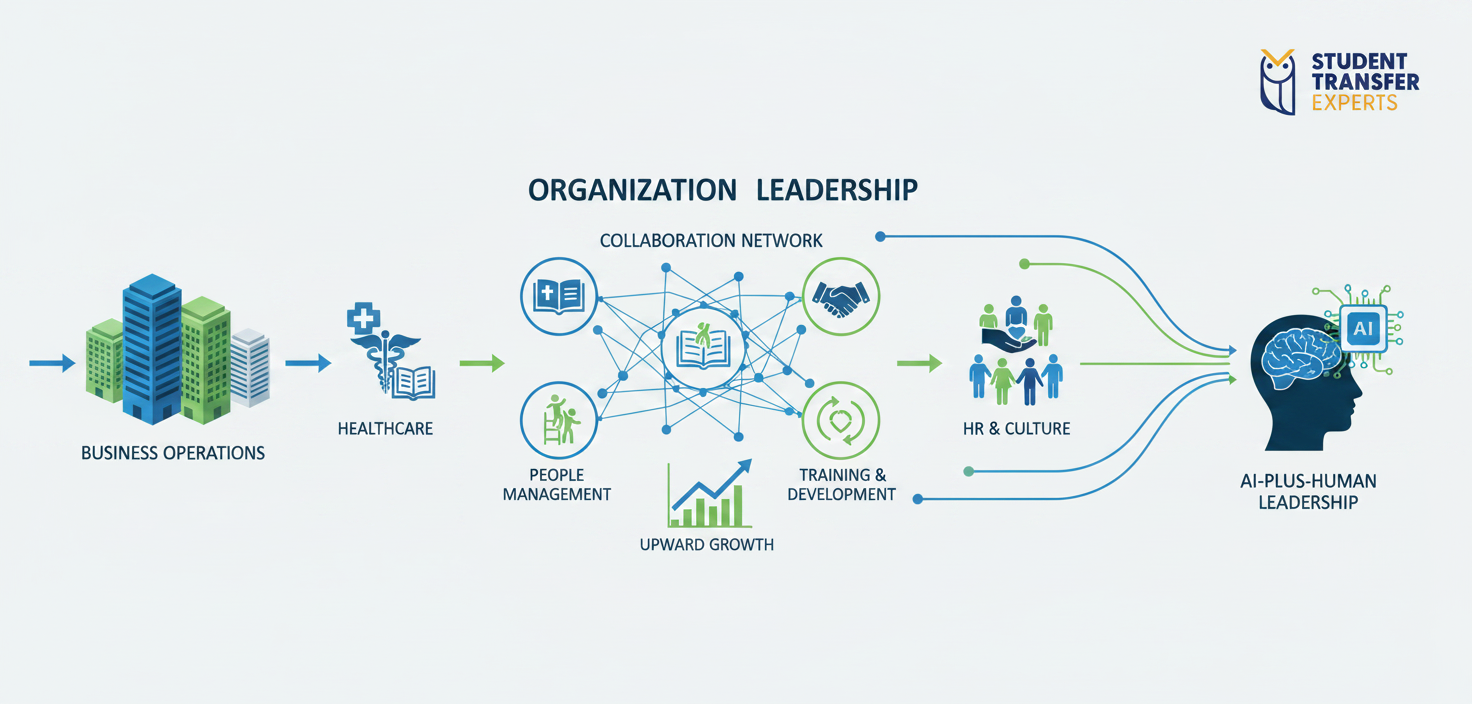
Infographic of Organizational Leqadership Industry Landscape
The organizational leadership field touches almost every major industry because every sector depends on effective leadership, people management, and organizational performance. Employers increasingly look for professionals who can guide teams through operational change, workforce shifts, digital transformation, and culture challenges.
Current research and industry reporting show several major trends shaping this space:
Human-centered leadership is rising in importance
Leadership research for 2025 and 2026 emphasizes empathy, clarity, trust, and resilience as essential workplace capabilities. This reflects employer concern about burnout, morale, retention, and engagement.
AI is changing leadership expectations
Organizations are not only adopting AI tools; they are also redefining what effective managers and leaders need to know. The emerging expectation is not deep coding expertise, but AI fluency: the ability to interpret outputs responsibly, question assumptions, and connect technology decisions to people and business outcomes.
Flatter organizations require influence skills
As organizations reduce hierarchy, more professionals are expected to lead laterally. That means success depends on collaboration, stakeholder management, communication, and credibility rather than title alone.
Employee experience and culture are strategic issues
HR and people leaders increasingly frame culture, learning, well-being, and development as core drivers of resilience and performance. Organizational leadership graduates are often well positioned to contribute here because their training connects leadership behavior with systems and outcomes.
Because of these trends, the industry landscape for organizational leadership is not confined to one employment bucket. Relevant employers may include:
corporations and mid-sized businesses
healthcare systems and administrative units
higher education and K-12 systems
nonprofit and mission-driven organizations
consulting and talent development firms
government and public service organizations
operations, logistics, and service organizations
Career pathways may include roles such as team lead, project manager, learning and development specialist, operations manager, organizational development associate, HR specialist, training manager, people operations analyst, or leadership development coordinator.
Why Low-Residency Works Especially Well for Organizational Leadership
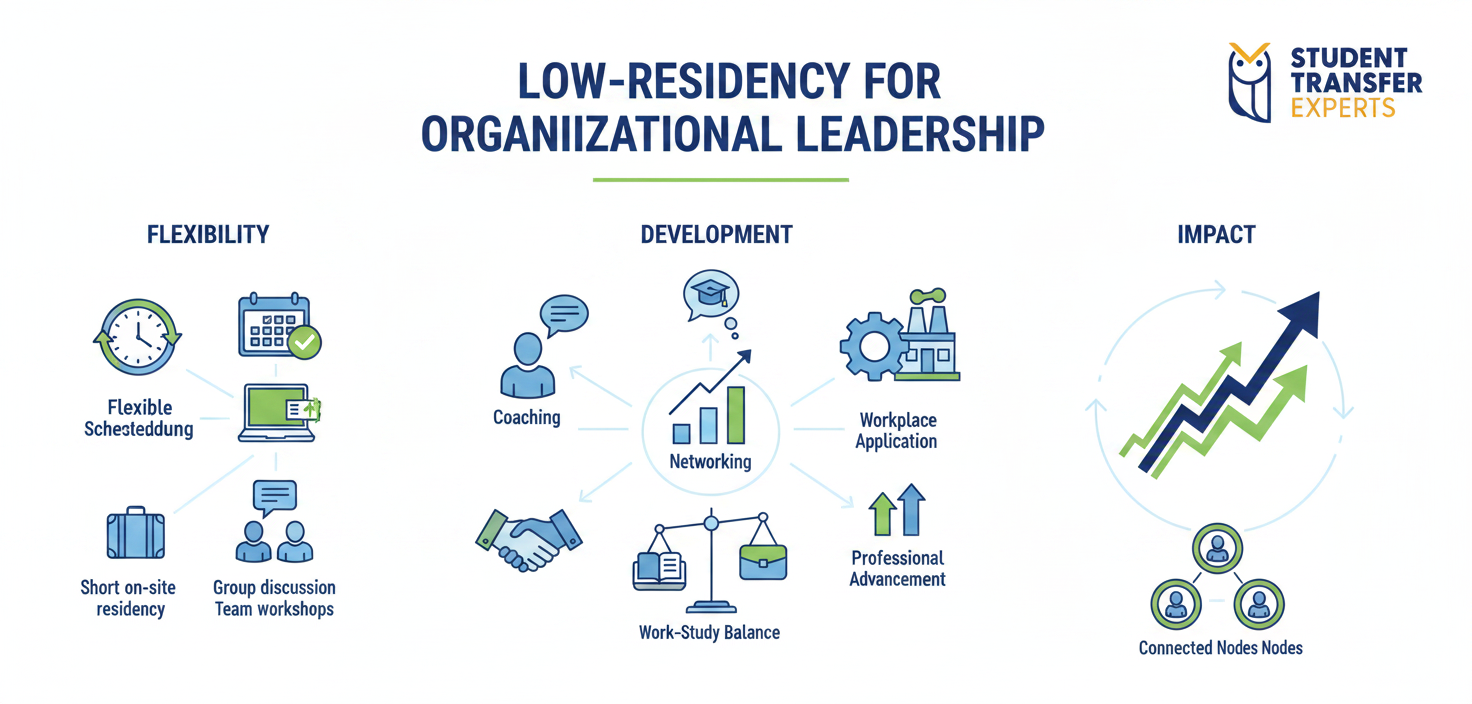
Infographic of Low-Residency for Organizational Leadership
A low-residency MS in Organizational Leadership is especially effective because the discipline depends on both reflection and interaction.
Online learning supports reading, discussion, case analysis, leadership models, organizational theory, and applied writing. But leadership also develops through practice. Periodic residencies can create space for the kinds of learning experiences that are harder to replicate fully online:
live team exercises
conflict and negotiation simulations
leadership coaching
peer feedback
collaborative strategy labs
networking with faculty and professionals
presentation and facilitation practice
For working professionals, this model is practical. It allows learners to continue employment, apply new ideas directly in the workplace, and return to short in-person sessions for intensive development. That is a strong match for workforce learning, where the goal is not just degree completion but immediate workplace relevance.
For transfer students, low-residency structure may also reduce disruption. Students who already have academic credit, work commitments, or family responsibilities often need a pathway that is flexible but still connected to faculty and peers. Low-residency can offer that middle ground between fully online distance education and constant on-campus attendance.
Comparison of Flexible Programme Structures
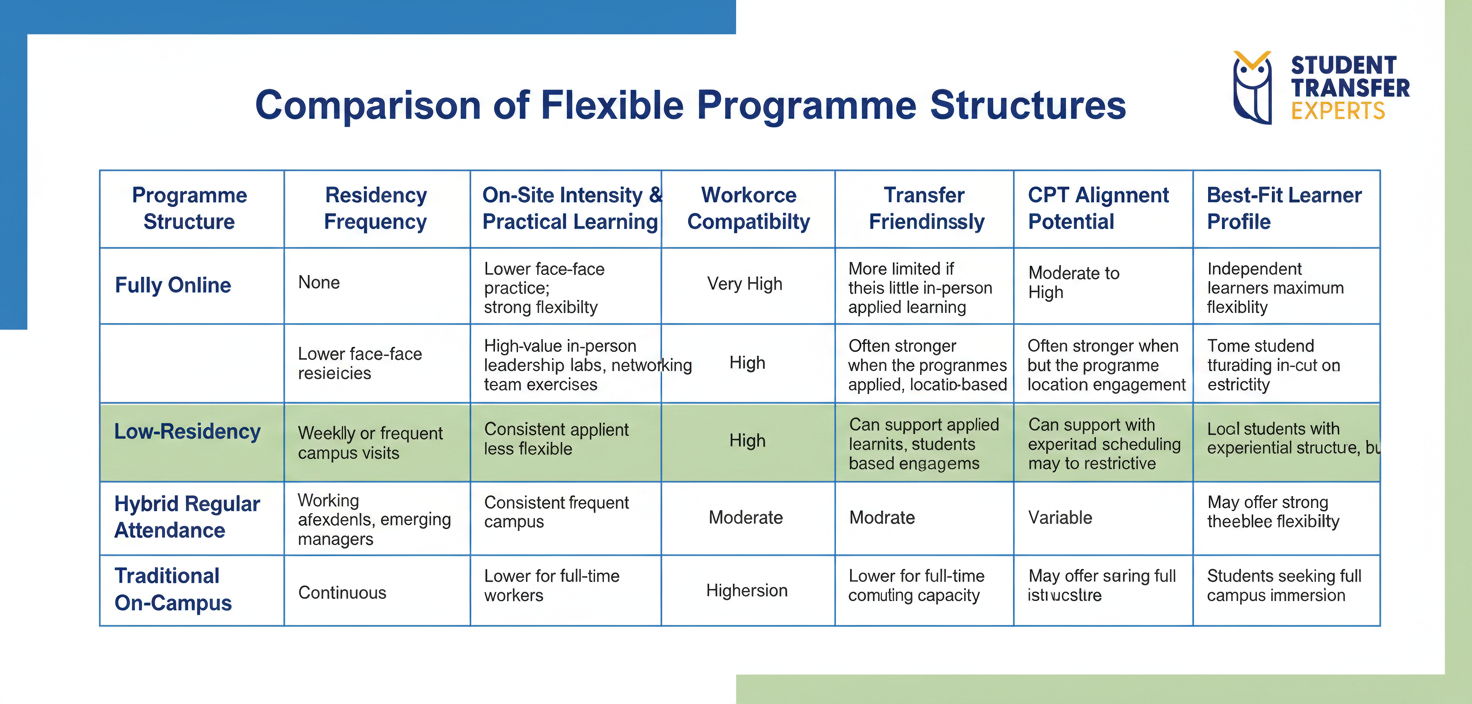
Comparison of Flexible Programme Structures
For organizational leadership, the low-residency model often stands out because the field benefits from real interaction without requiring constant physical attendance. Learners can study leadership frameworks online and then test them in residency settings through dialogue, feedback, and applied exercises.
Curriculum & Skills: What Learners Actually Build
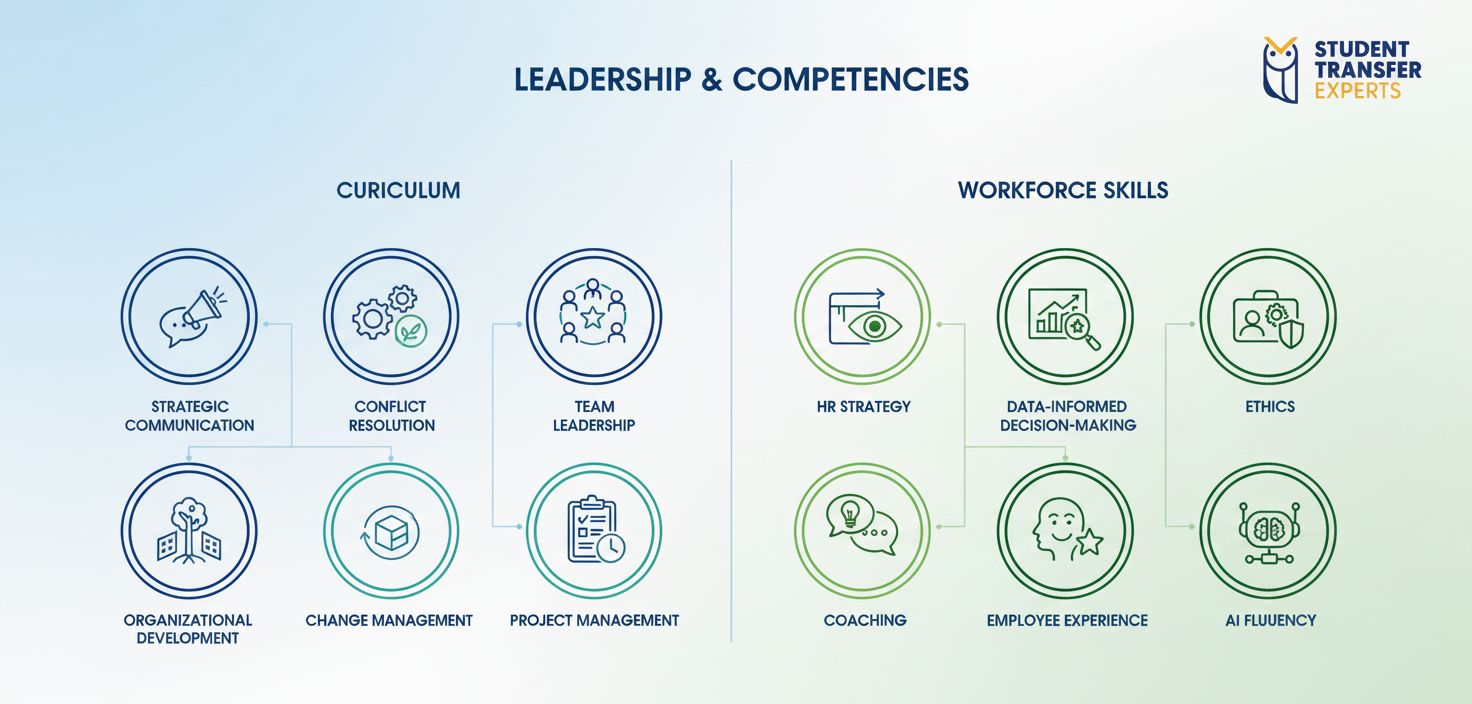
Infographic of Curriculum and Skills
An MS in Organizational Leadership is valuable when it develops concrete workplace skills rather than staying at the level of abstract theory. Strong programmes typically help learners build competencies such as:
Strategic communication
Students learn how to communicate across teams, lead meetings, manage stakeholder expectations, and frame decisions clearly in periods of change.
Change management
This is central to the discipline. Learners study how organizations adopt new systems, respond to disruption, and guide people through transition.
Team leadership and collaboration
Graduates are often expected to lead across functions, manage group dynamics, and build trust in matrixed or cross-departmental environments.
Conflict resolution and negotiation
Leadership roles frequently involve friction, competing priorities, and interpersonal challenges. Programmes in this field often train students to navigate those realities constructively.
Organizational development
Students learn how structures, culture, incentives, and communication systems shape performance.
Data-informed decision-making
Organizational leadership is increasingly tied to metrics, employee feedback, performance indicators, and workplace
Ethics, culture, and employee experience
Modern leadership requires more than efficiency. It also requires attention to fairness, inclusion, morale, and the broader employee environment.
AI fluency and adaptive leadership
As leadership expectations evolve, professionals need to understand how digital tools and AI influence work, teams, and decision-making.
These are highly transferable skills. That matters for learners who want career advancement without locking themselves into one narrow function.
How Industry Values These Skills
Employers tend to value applied leadership skills because organizations do not operate in silos. A technically strong employee is useful, but the person who can align people, communicate across departments, handle change, and sustain execution often becomes even more valuable over time.
In organizational leadership, that means employers often look for evidence of:
practical communication ability
sound judgment
team coordination
project and people management
training or coaching capacity
culture and engagement awareness
adaptability in uncertain environments
Relevant organizations may include private employers, public agencies, nonprofits, educational institutions, healthcare systems, and consulting firms. In many of these settings, applied learning is preferred because employers need leaders who can step into real ambiguity, not just explain leadership concepts in theory.
That is another reason low-residency learning fits well. It allows students to connect classroom concepts with ongoing workplace challenges, which can strengthen both confidence and employability.
Value for Transfer Students
Transfer students considering a low-residency MS in Organizational Leadership should evaluate the degree through both academic and workforce lenses.
CPT/OPT relevance
Organizational leadership can connect to roles in operations, HR, training, project coordination, leadership development, and organizational support functions. CPT/OPT relevance depends on the specific programme, course design, role alignment, institutional policy, and student status. Our university partners can help students assess whether a role connects appropriately to the academic programme. This should always be reviewed carefully and early.
CGPA and credit transfer flexibility
Transfer learners often need clarity on prior coursework, eligibility, and pathway planning. In practice, graduate transfer flexibility varies, but students with prior US study, related academic backgrounds, or partially completed programmes may have options worth evaluating. Our university partners may offer more flexible review patterns than students expect, especially when coursework aligns with leadership, management, communication, business, or social science foundations.
Residency requirements and practical value
Low-residency formats usually require limited but meaningful on-campus engagement. For this field, that can be an advantage rather than a barrier because in-person workshops strengthen leadership practice, peer learning, and professional confidence.
Cost advantages
Compared with more traditional full-residency pathways, some partner options may offer cost advantages through more flexible structures, reduced relocation pressure, or more efficient pathway planning. The right fit depends on transfer credit, delivery format, and completion timeline.
Visa and immigration process guidance
Students already in the US often need practical clarity on enrollment structure, academic continuity, documentation timing, and status-related planning. While this is not legal advice, it is important to review programme format, residency expectations, and work authorization questions early in the decision process. An informed transfer plan can reduce avoidable delays.
Where STE can be helpful is in translating these variables into an actionable pathway. Even though the STE knowledge source was unavailable in this session, students typically use TransferGPT and advising support to compare transfer possibilities, clarify programme fit, and understand how their background may align with partner pathways.
Who This Programme Is For
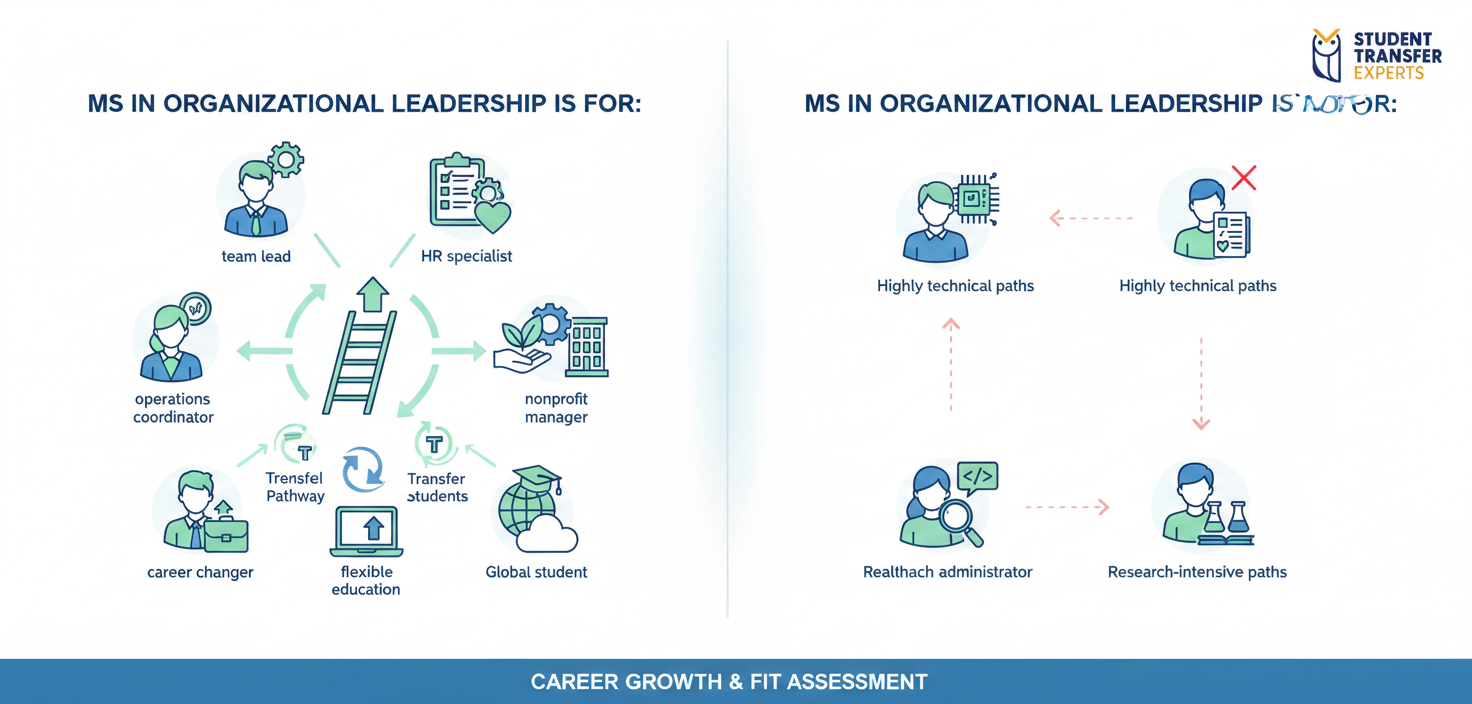
Infographic of who this Programme is for
A low-residency MS in Organizational Leadership is often a strong fit for:
working professionals moving into supervisory or managerial responsibility
transfer students with backgrounds in business, communication, education, psychology, healthcare administration, or public service
HR, operations, nonprofit, and team-based professionals seeking advancement
career changers who want a broadly applicable leadership credential
learners who want flexibility but still value periodic in-person engagement
In short, this programme is best for learners who want to lead people and improve organizations, not just master one narrow technical function.
Take the Next Step
If you're ready to evaluate your academic or professional pathway:
👉 Begin Your Application / Evaluation
https://form.typeform.com/to/HRz41hcQ
If you need clarity on: Transfers • Fresh admissions • STEM pathways • CPT/OPT • Low-residency formats • Career alignment
👉 Ask STE GPT your questions first
https://gpt.studenttransferexperts.com/
Final Takeaway
A low-residency MS in Organizational Leadership supports workforce learning because it matches how leadership actually develops: through flexible study, immediate workplace application, and periodic high-value interaction. It also supports transfer continuity because it can give students a practical, adaptable degree path without forcing an all-or-nothing choice between work, study, and mobility.
For students already in the US, the right question is not just whether organizational leadership is a useful degree. It is whether the programme format, credit pathway, professional outcomes, and transfer strategy align with your next step. When evaluated carefully, low-residency organizational leadership can be a smart option for learners who want flexibility, leadership growth, and stronger career mobility across industries.
#MSOrganizationalLeadership #OrganizationalLeadership #LowResidencyEducation #TransferStudents #WorkforceLearning #FlexibleEducation #CareerAdvancement #LeadershipDevelopment #ChangeManagement #OnlineEducation #HigherEducation #StudentTransferExperts #TransferGPT