Why Low-Residency Professional MBA – Finance Concentration Programmes Matter

Blog title image
Introduction
The Professional MBA with a Finance Concentration is a graduate-level business degree designed for professionals seeking advanced expertise in financial management, investment analysis, and strategic decision-making. Unlike traditional full-time MBAs, low-residency formats blend online coursework with periodic, intensive on-site sessions—offering a flexible, workforce-friendly pathway for career advancement and academic progression.
For workforce learners and transfer students, this format is especially valuable. It enables continued employment, supports professional development, and allows for seamless credit transfer and pathway optimization. In today’s rapidly evolving financial sector, the ability to upskill without pausing your career is a strategic advantage.
Understanding the Programme: Professional MBA – Finance Concentration
A Professional MBA with a Finance Concentration prepares learners for leadership roles in corporate finance, investment banking, financial analysis, and strategic planning. The curriculum is designed to build core business acumen—spanning accounting, management, marketing, and operations—while providing deep specialization in financial markets, asset management, risk assessment, and portfolio strategy.
Specialization in finance equips graduates to:
Analyze and interpret complex financial data
Make informed investment and capital allocation decisions
Navigate regulatory and compliance frameworks
Lead teams in high-stakes financial environment
This discipline is critical in today’s economy, where financial expertise drives organizational growth, risk management, and innovation across sectors.
The Finance Industry Landscape
The finance sector is dynamic, global, and highly competitive. Major employers include investment banks, commercial banks, asset management firms, consulting agencies, fintech companies, and multinational corporations. The industry is shaped by rapid technological innovation (e.g., fintech, blockchain), evolving regulatory standards, and increasing demand for data-driven decision-making.
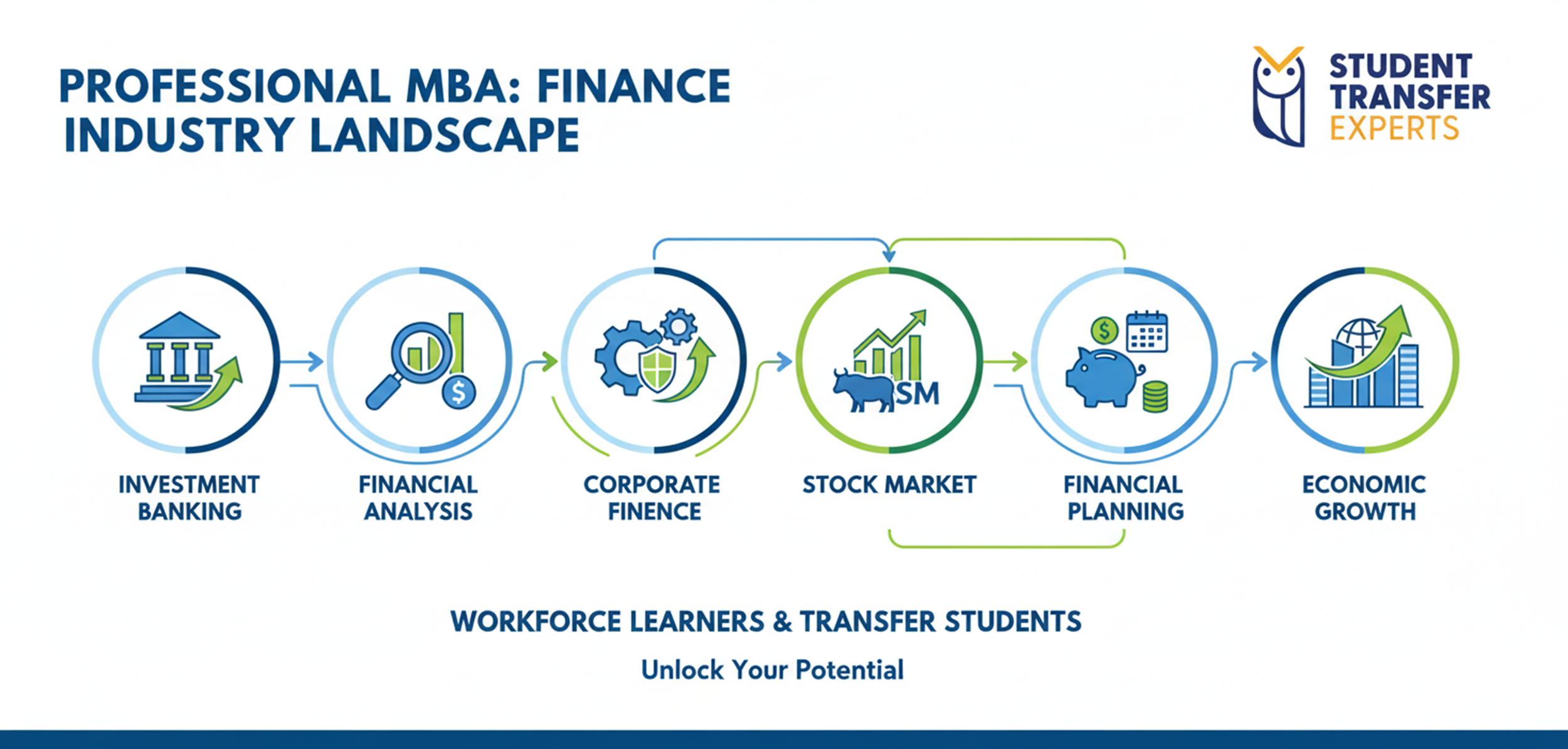
Infograohic of Professional MBA Industry Landscape
Key trends include:
Digital Transformation: Automation, AI, and data analytics are reshaping financial services.
Sustainable Finance: ESG (Environmental, Social, Governance) investing is on the rise.
Globalization: Cross-border transactions and international finance are increasingly important.
Regulatory Complexity: Compliance and risk management are critical skills.
Career opportunities span financial analysis, investment management, corporate finance, risk assessment, and executive leadership. Professional organizations such as the CFA Institute, Financial Management Association, and local business chambers provide networking and professional development.
Why Low-Residency Works Especially Well for Finance
Low-residency MBA programmes are uniquely suited to finance professionals and transfer students for several reasons:
Periodic On-Site Learning: Intensive residencies offer hands-on workshops, networking with industry leaders, and collaborative projects—crucial for building real-world skills and professional relationships.
Flexibility: Online coursework allows learners to balance work, study, and personal commitments, making it ideal for working professionals and those with family obligations.
Workforce-Friendly Design: Cohort-based models and asynchronous learning support ongoing employment and career progression.
Transfer Pathways: Low-residency formats often feature modular curricula, facilitating credit transfer and recognition of prior learning.
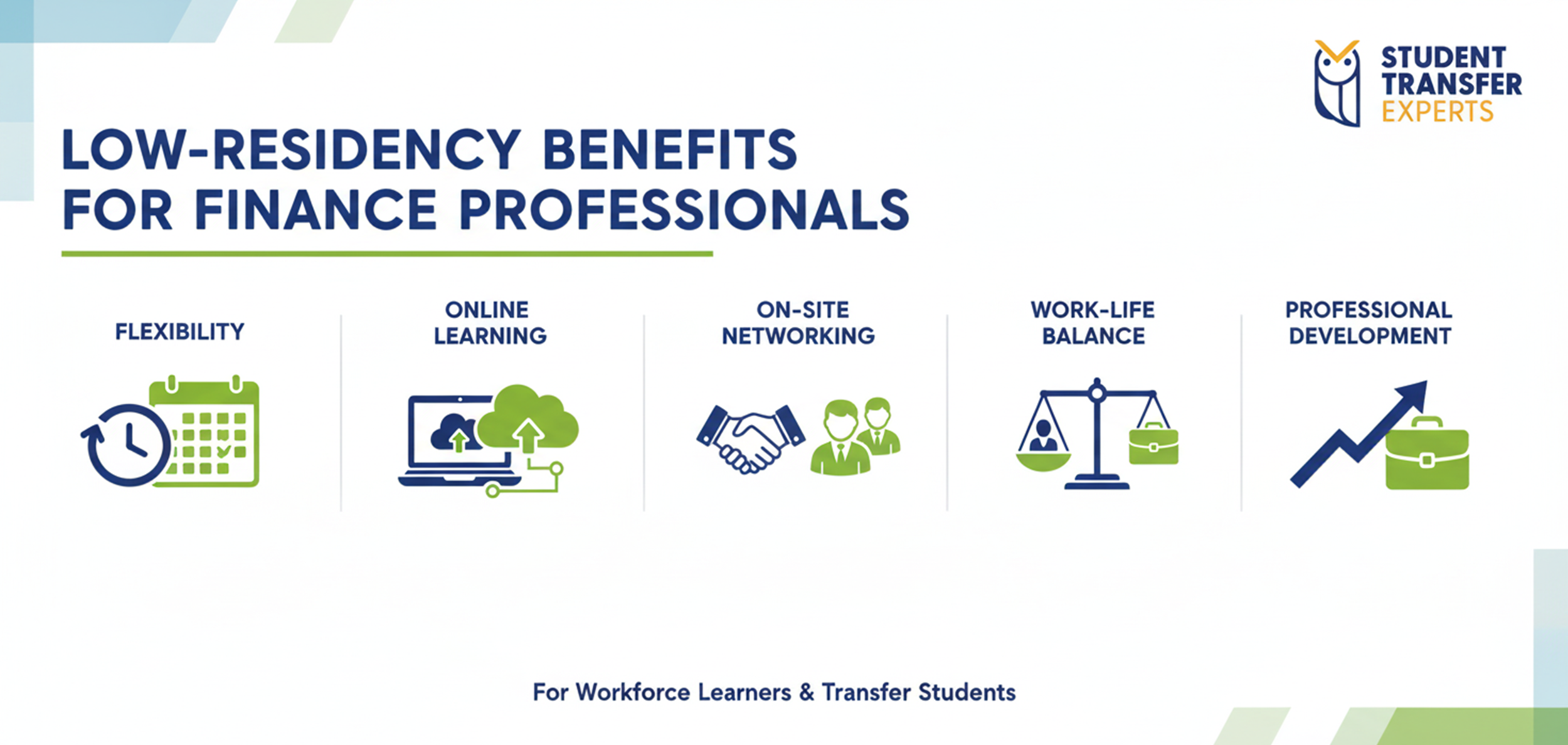
Infograohic of Low-Residency Benefits for Finance Professionals
For finance professionals, the ability to immediately apply classroom learning to workplace challenges enhances both academic and career outcomes.
Comparison of Flexible Programme Structures:
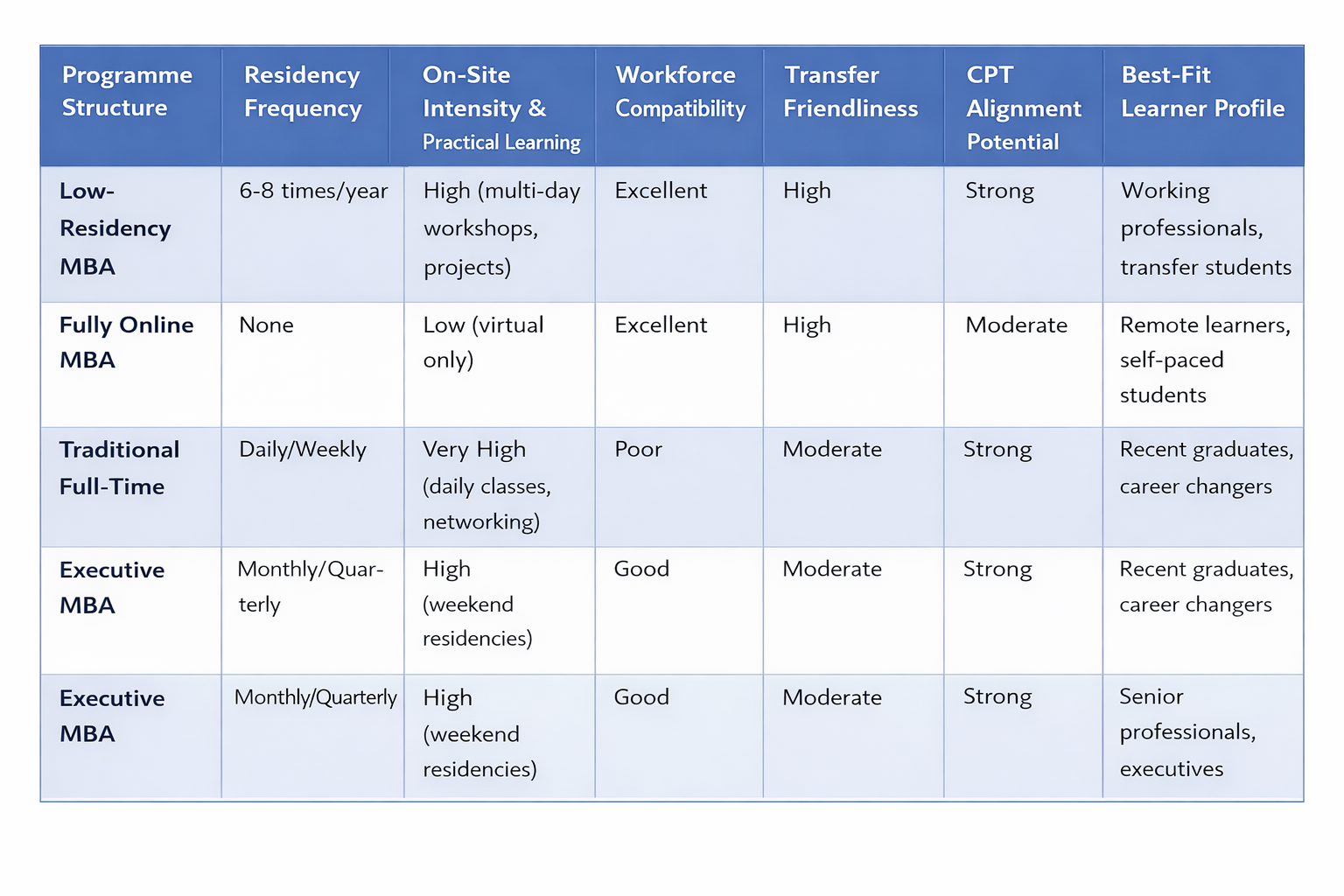
Table of Comparison of Flexible Program Structures
Interpretation for Finance:
Low-residency MBAs offer the optimal blend of flexibility and practical engagement for finance professionals. The periodic residencies enable deep dives into financial modeling, case competitions, and networking—while online modules ensure continued workforce participation and transfer pathway optimization.
Curriculum & Skills: What Learners Actually Build:
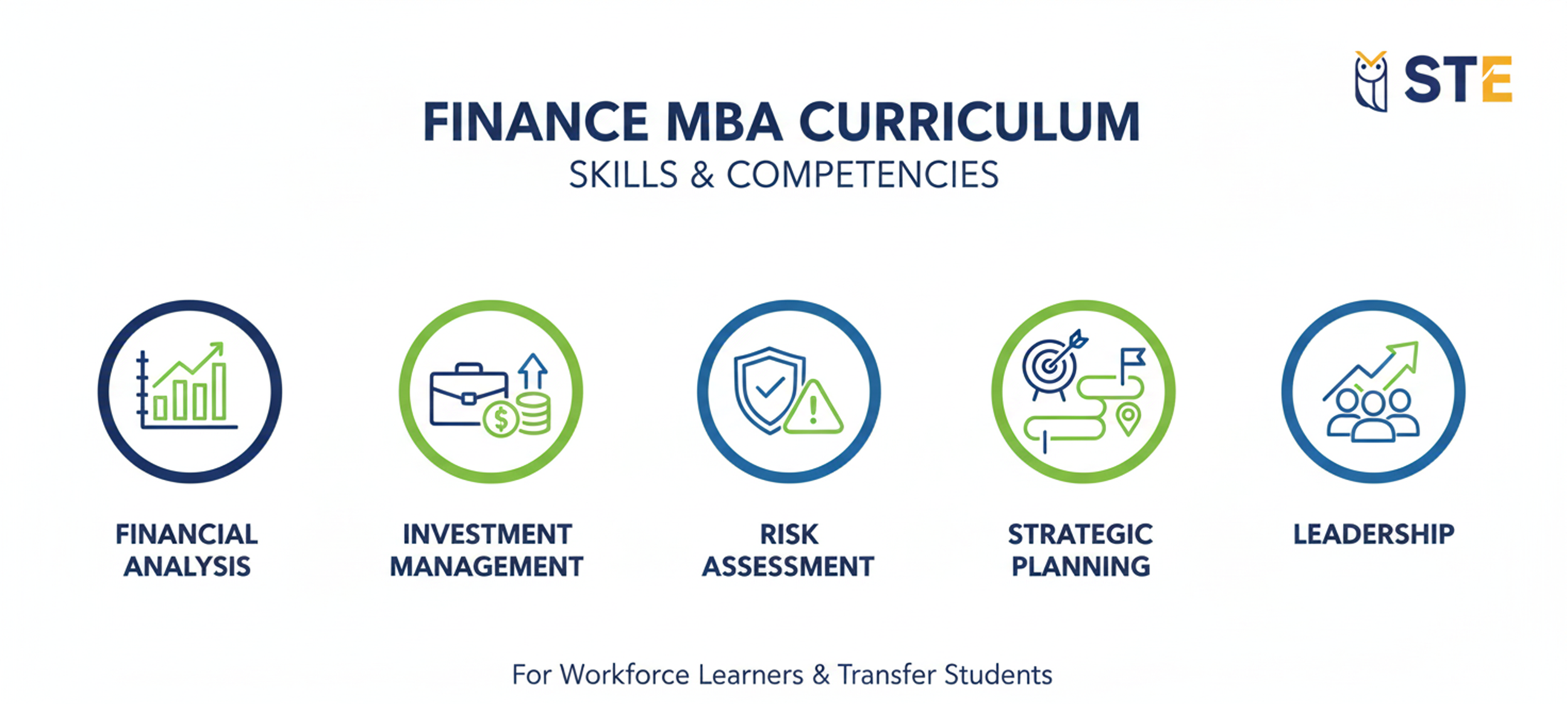
Infograohic of Finance MBA Curriculum
A Professional MBA – Finance Concentration develops:
Financial Analysis: Mastery of financial statements, ratio analysis, and valuation techniques
Investment Management: Portfolio construction, asset allocation, and risk-return optimization
Corporate Finance: Capital budgeting, cost of capital, and strategic financial planning
Risk Assessment: Identifying, measuring, and managing financial risks
Strategic Leadership: Decision-making, team management, and ethical leadership
Data-Driven Decision Making: Use of analytics, modeling, and financial software tools
Applied projects, simulations, and case studies ensure that skills are workforce-relevant and immediately applicable.
How Industry Values These Skills
Employers in finance seek professionals who can:
Interpret complex data and provide actionable insights
Lead teams and manage projects in high-pressure environments
Navigate regulatory and compliance challenges
Communicate effectively with stakeholders and clients
Organizations such as investment banks, consulting firms, asset managers, and fintech startups value applied learning and practical experience over purely theoretical knowledge. Certifications like CFA or CFP, often supported by MBA curricula, further enhance employability.
Value for Transfer Students
Low-residency Professional MBA programmes are highly transfer-friendly:
CPT/OPT Relevance: Finance roles often qualify for Curricular Practical Training (CPT) and Optional Practical Training (OPT), enabling international students to gain US work experience during and after their studies.
CGPA and Credit Transfer: University partners typically offer flexible CGPA requirements and recognize prior coursework, streamlining the transfer process.
On-Campus Residency: Short, intensive residencies fulfill in-person learning requirements and support visa compliance, without requiring full-time relocation.
Cost Advantages: Low-residency and online formats often reduce overall costs (tuition, living expenses) compared to traditional programmes.
Visa and Immigration Guidance: Our university partners provide advisory support for visa processes, though not legal advice.
STE’s TransferGPT and TransferBuddy tools help students map optimal pathways, assess credit transfer potential, and navigate CPT/OPT opportunities specific to finance.
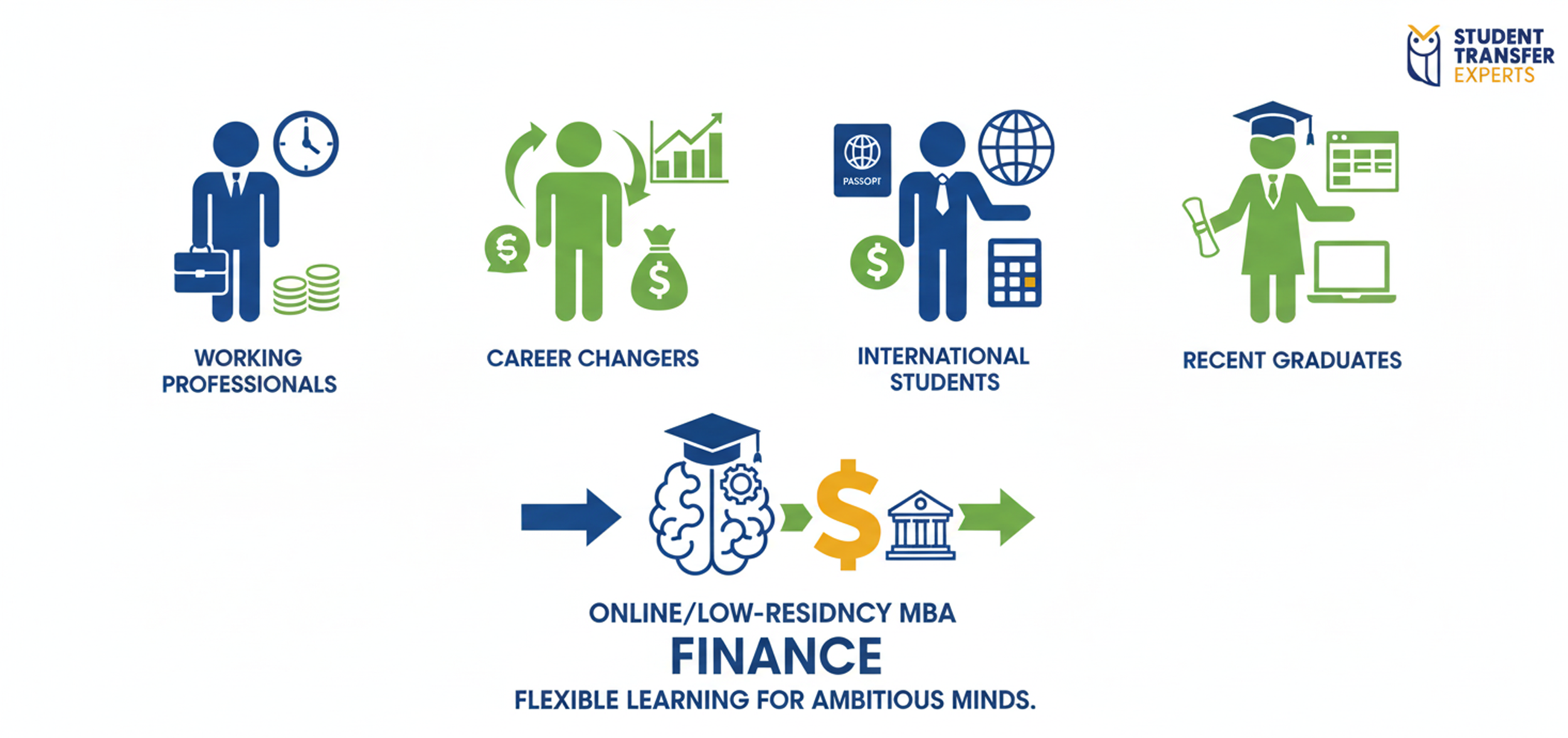
Infograohic of Who the Low-Residency MBA in Finance is for
Who this Programme is for
Best suited for:
Working professionals in finance, accounting, or business roles seeking advancement
Transfer students with prior business or finance coursework
International students aiming for US work experience via CPT/OPT
Career changers with quantitative backgrounds
Take the Next Step
If you're ready to evaluate your academic or professional pathway:
👉 Begin Your Application / Evaluation
If you need clarity on: • Transfers • Fresh admissions • STEM pathways • CPT/OPT • Low-residency formats • Career alignment
👉 Ask STE GPT your questions first
SEO Hashtags & Keywords
#LowResidencyEducation #TransferStudents #FinanceMBA #WorkforceLearning #FlexibleEducation #CareerAdvancement #OnlineEducation #HigherEducation #StudentTransferExperts #TransferGPT #FinanceCareers #CPT #OPT #BusinessLeadership #ProfessionalMBA