MS in Digital Marketing Low-Residency Programmes for Transfer Students and Workforce Learners
Blog Title Image
Introduction: Why Low-Residency MS in Digital Marketing Programmes Matter
An MS in Digital Marketing sits at the intersection of business strategy, customer psychology, analytics, technology, and communication. Unlike a broad general marketing degree, this programme is usually designed around how brands attract, convert, retain, and understand audiences across digital channels such as search, paid media, social platforms, email, mobile, ecommerce, and analytics environments.
That matters because marketing roles have changed. Employers now expect marketers to do more than write campaigns or manage content calendars. They increasingly want professionals who understand customer journeys, attribution, digital advertising, SEO/SEM, performance measurement, AI-assisted content workflows, privacy-aware targeting, and platform-based decision-making.
A low-residency format works especially well for this field because digital marketing is already practised in distributed, platform-driven environments. Learners can complete much of the academic work remotely while still benefiting from periodic on-site experiences for collaboration, presentation practice, networking, applied workshops, and faculty feedback. For workforce learners and transfer students already studying in the US, this can strike an effective balance among continuity, flexibility, and career momentum.
In practical terms, a low-residency MS in Digital Marketing can support students who want to:
continue studying without fully disrupting work schedules,
build a stronger transfer pathway into a career-aligned graduate degree,
gain applied skills that connect directly to current employer demand,
and evaluate CPT/OPT-relevant opportunities in marketing-related roles.
Understanding the Programme: MS in Digital Marketing
An MS in Digital Marketing typically prepares learners for roles that combine strategic thinking with measurable execution. The strongest programmes do not treat digital marketing as “just social media.” Instead, they build capability across the full commercial funnel: market research, audience segmentation, content strategy, campaign design, search visibility, paid promotion, analytics, testing, brand building, and customer experience.
Recent curriculum patterns in the field show a shift toward applied learning in areas such as:
digital marketing strategy,
consumer behaviour in digital environments,
customer journey analytics,
marketing research,
digital law, policy, and ethics,
search engine marketing,
social media marketing,
content marketing,
digital advertising and promotion,
UX/UI and customer-centric design,
AI in marketing,
e-commerce, and retail marketing.
One representative curriculum source reviewed in research included explicit use of tools and platforms such as Google Analytics, Hootsuite, and Tableau, plus coursework in SEO, PPC, A/B testing, analytics culture, AI-enabled marketing, privacy, and customer retention strategy. That kind of structure is important because it reflects where the discipline is moving: toward measurable business impact, not only creative execution.
Why does this discipline matter now? Nearly every industry relies on digital demand generation, customer acquisition, retention, brand positioning, and audience insight. Whether a learner wants to work in healthcare, retail, education, tech, nonprofits, media, or consulting, digital marketing has become a transferable commercial skillset.
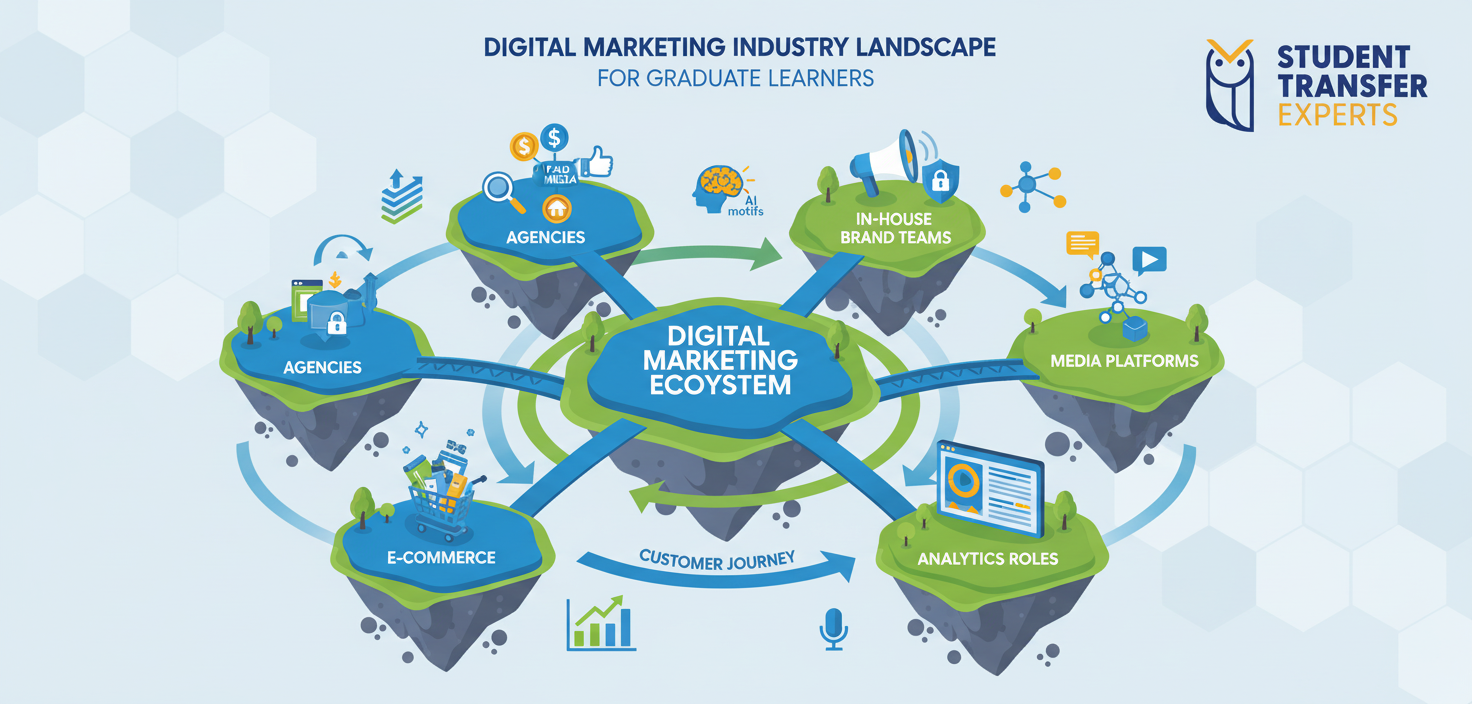
The Digital Marketing Industry Landscape
Infographic of Digital Marketing Landscape
The digital marketing industry is expanding in complexity, not just size. Employers are no longer hiring only for a broad “marketing” capability. They are building teams around specialisations such as:
performance marketing,
SEO and search visibility,
paid social,
lifecycle and CRM marketing,
content strategy,
ecommerce growth,
marketing analytics,
conversion optimization,
audience research,
brand and digital communications.
Current trends from recent industry coverage and programme research point to several important developments:
AI is reshaping workflows
Marketing teams are adjusting to AI-assisted content production, AI search experiences, and new expectations around discoverability in answer engines and zero-click environments. This affects SEO, content architecture, paid strategy, and reporting.
Privacy-first measurement is becoming more important
As digital advertising becomes more regulated and attribution becomes harder, employers increasingly value marketers who understand measurement frameworks, experimentation, first-party data logic, and ethical campaign design.
Retail media and performance marketing are growing
Recent industry reporting highlights employer demand in analytics, performance marketing, and retail media ecosystems, especially as brands shift budget toward measurable, platform-based channels.
Omnichannel customer journeys matter more
The ability to connect web, mobile, app, e-commerce, CRM, and offline touchpoints into one coherent view of customer behaviour is now a competitive skill.
For students, this means an MS in Digital Marketing is most valuable when it teaches both strategic interpretation and operational execution. A learner should graduate able to explain not only what to do, but why it works, how to measure it, and how to adjust it.
Why Low-Residency Works Especially Well for Digital Marketing
Infographic of Low Residency Digital Marketing
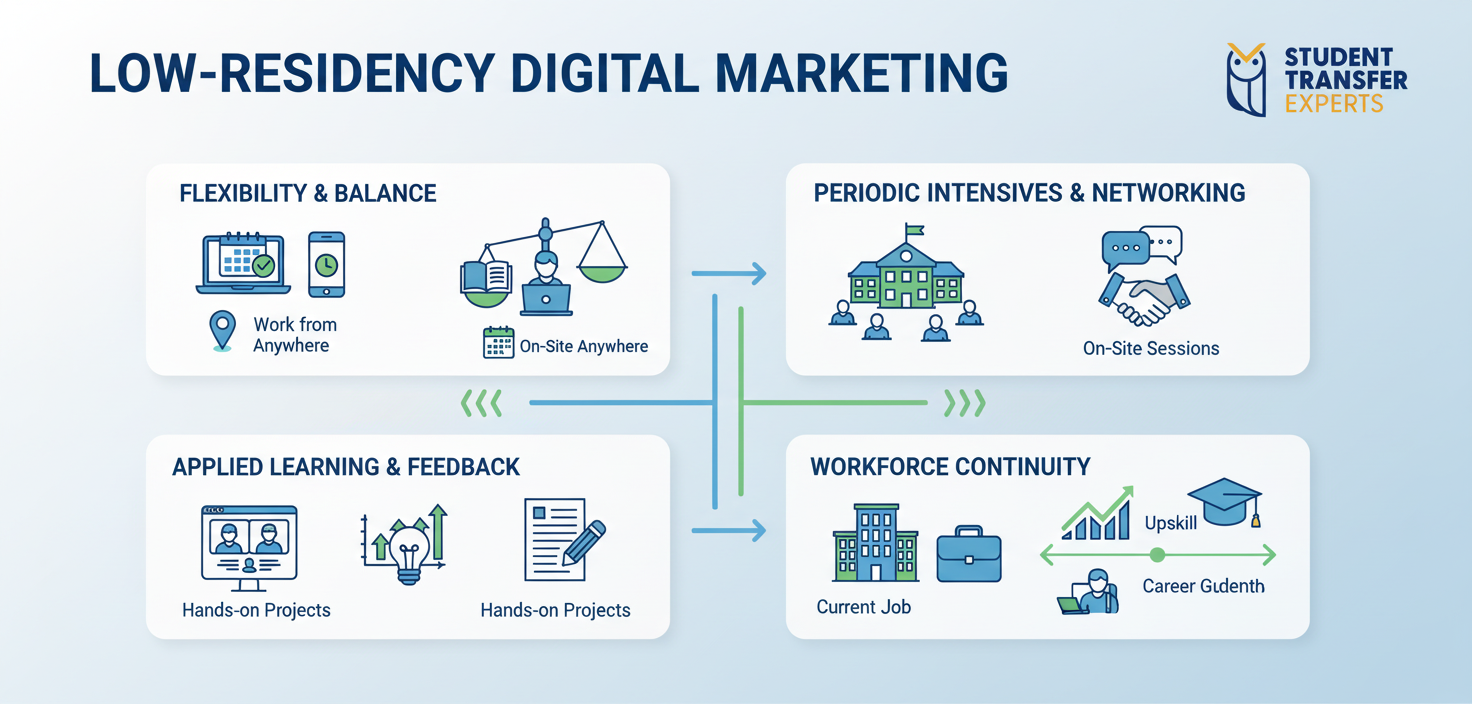
Digital marketing is particularly compatible with low-residency learning because the field itself is hybrid by nature. Most core tasks are performed through digital platforms, dashboards, collaboration software, and distributed teams. That makes remote study viable. But the field also benefits from periodic in-person experiences.
Those residency periods can add real value through:
Applied workshops
Search strategy, campaign analysis, media planning, audience segmentation, UX review, and pitch presentations often improve when students can work live with faculty and peers.
Portfolio and project feedback
Marketing hiring often favours demonstrated work. On-site sessions can be useful for refining campaign presentations, analytics narratives, and capstone outputs.
Networking and professional identity
Many digital marketing roles are filled through referrals, project exposure, and industry-facing conversations. Short in-person residencies can help learners build stronger networks than a fully asynchronous model.
Better fit for working professionals
Low-residency formats reduce the need for constant physical attendance while preserving structure. That matters for learners balancing jobs, internships, family obligations, or transfer logistics.
For transfer students, the format can also reduce disruption. If a learner is already in the US and trying to maintain academic momentum while planning the next step, a low-residency pathway can make more sense than a programme that demands continuous full-time physical presence.
Comparison of Flexible Programme Structures
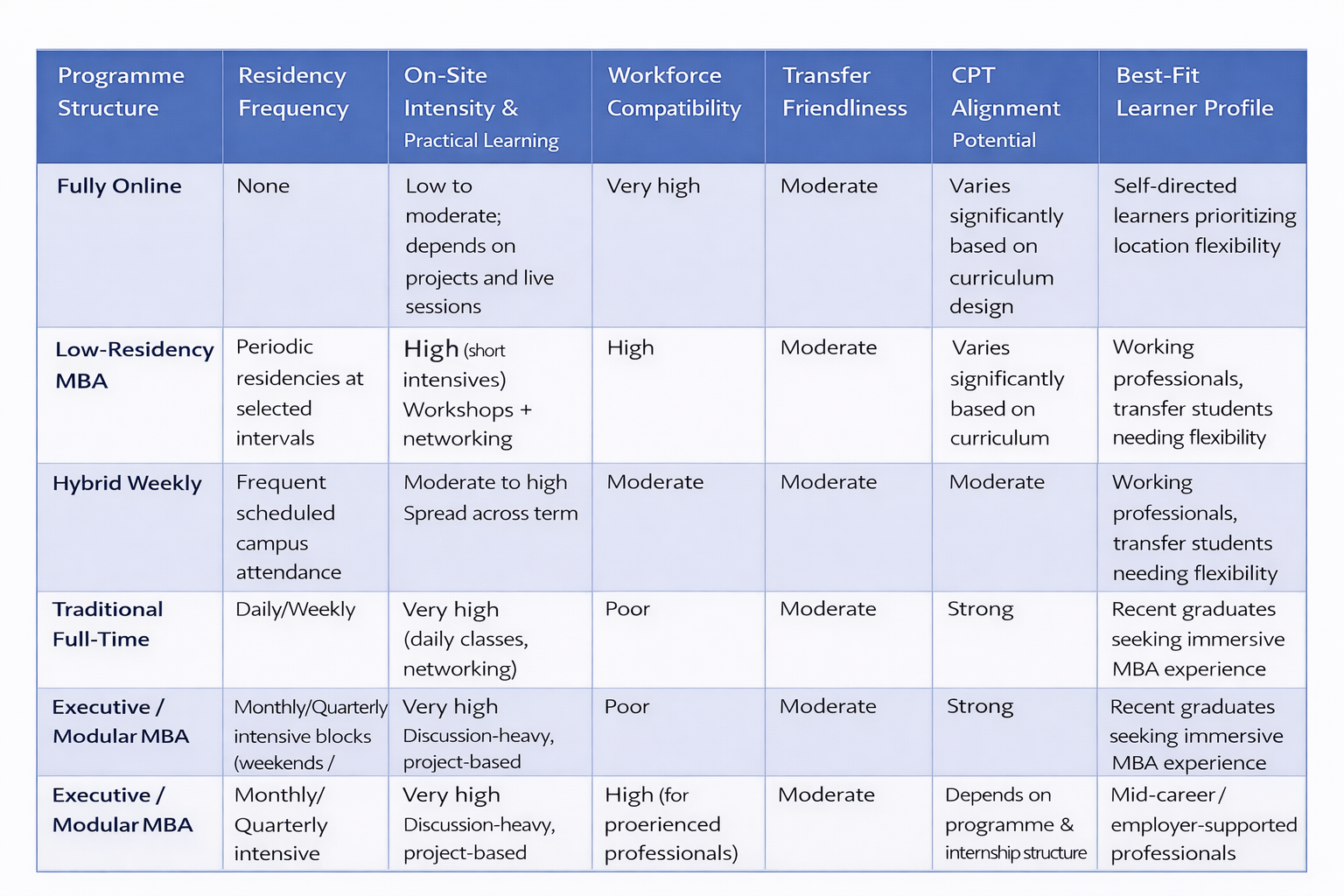
Table of Comparison of Flexible Programme Structures
For digital marketing, low-residency often strikes the best balance. It preserves access to remote, tool-based learning while creating space for practical intensives around campaign strategy, analytics interpretation, and capstone communication.
Curriculum & Skills: What Learners Actually Build
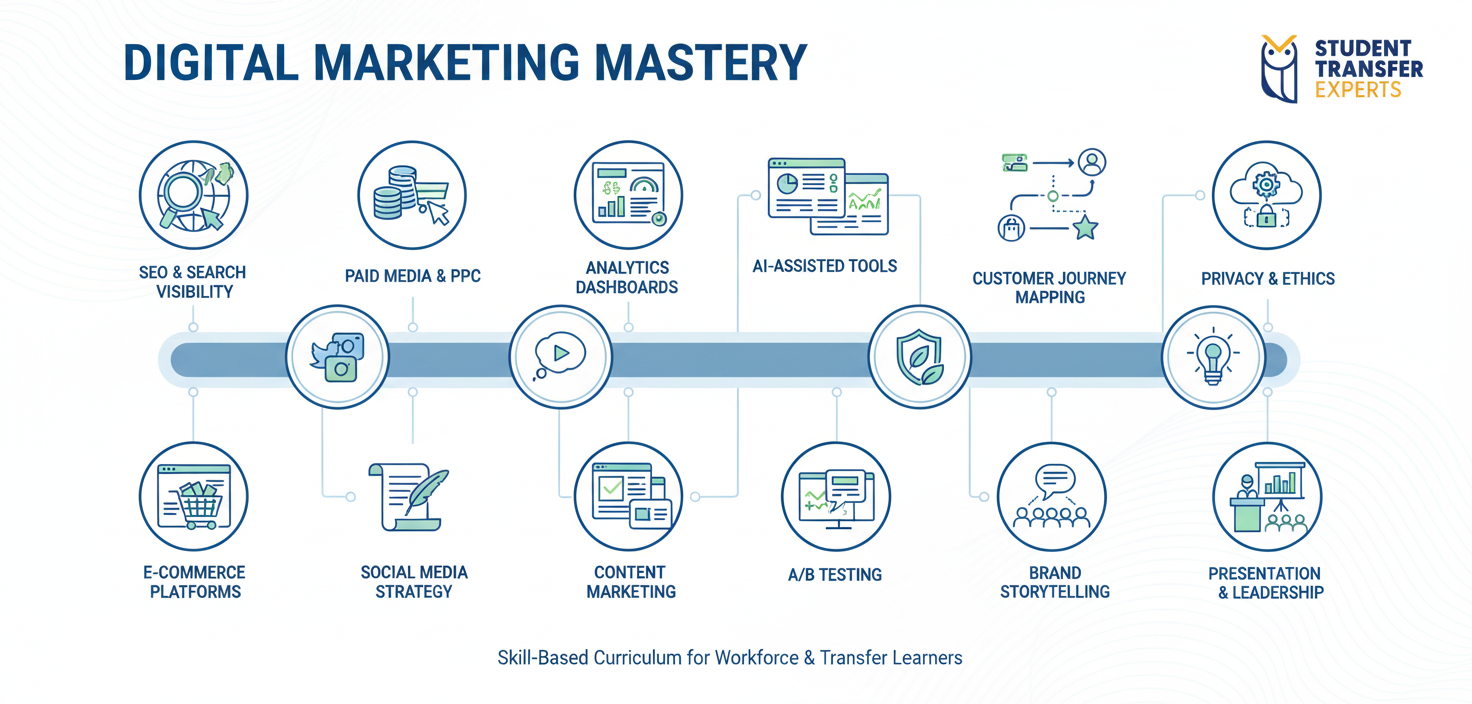
Infographic of Digital Marketing Curriculum
A strong MS in Digital Marketing should help learners build both specialist skills and cross-functional business judgment.
Core competencies often developed
Digital strategy
Students learn how channels fit together across awareness, consideration, conversion, and retention.
Marketing analytics
This includes dashboards, KPI selection, attribution logic, funnel analysis, campaign performance review, and customer journey interpretation.
Search and discoverability
Modern search work now extends beyond classic SEO into paid search, AEO, AI-assisted search visibility, and intent-based content strategy.
Paid media and campaign planning
Learners often build competence in bidding logic, audience targeting, testing, creative optimisation, and media budgeting.
Consumer behavior and audience insight
Understanding why people click, compare, trust, hesitate, and convert is still central to the field.
Content and brand storytelling
Digital marketers must create or guide content that performs across platforms while staying aligned with positioning and brand goals.
Legal, ethical, and privacy awareness
As data use becomes more scrutinised, marketers increasingly need literacy in privacy, transparency, fairness, intellectual property, and responsible use of AI.
UX and customer experience
Marketers are now expected to understand landing pages, user flows, friction points, and conversion barriers.
Industry-standard tools and methods
Depending on programme design, learners may encounter tools and workflows related to:
analytics dashboards,
social media management platforms,
campaign reporting,
content planning tools,
CRM and email systems,
testing frameworks,
visualization platforms,
AI-assisted ideation and optimisation.
For workforce learners, the real advantage is not only learning the tools, but learning how to make decisions from the data those tools produce.
How Industry Values These Skills
Employers in digital marketing generally value people who can combine three things:
business understanding,
platform fluency,
evidence-based decision-making.
That is why applied graduate education can be valuable in this field. A candidate who can explain campaign strategy, measure performance, interpret audience behaviour, and communicate recommendations clearly often stands out more than someone with only theoretical marketing knowledge.
Relevant employer environments include:
in-house marketing teams,
advertising and media agencies,
ecommerce firms,
startups,
retail brands,
healthcare systems,
higher education institutions,
nonprofit organizations,
consulting firms,
software and technology companies.
Applied learning matters because marketing work is iterative. Employers want marketers who can test, learn, optimize, and justify decisions. They also want communication skills: presenting findings, defending strategy, and collaborating across creative, product, sales, and leadership teams.
Value for Transfer Students
For transfer students already studying in the US, a low-residency MS in Digital Marketing can be a practical way to preserve momentum while moving into a more workforce-relevant programme.
CPT/OPT relevance for digital marketing roles
Digital marketing roles can align with practical training when the position is clearly related to the academic field and when the programme structure supports that practical component. Typical related roles may include:
digital marketing intern,
SEO/SEM analyst,
marketing analyst,
content strategist,
social media specialist,
ecommerce marketing associate,
paid media coordinator,
CRM/lifecycle marketing assistant,
brand or growth marketing analyst.
As always, CPT is programme-specific and school-specific. In general, CPT must be tied to the curriculum and authorised before work begins. Public guidance from institutional international offices consistently shows that CPT usually requires:
valid F-1 status,
full-time enrollment for the required period,
a role directly related to the field of study,
academic approval,
and formal authorisation before the start date.
Students should treat all CPT/OPT planning as an academic and immigration compliance process, not just an employment decision.
CGPA and credit transfer flexibility
Because the STE knowledge base was unavailable during this session, I cannot responsibly state programme-specific internal partner thresholds. But in general, transfer-friendly planning for this field often depends on:
prior business, communication, analytics, or related coursework,
graduate readiness shown through CGPA trends,
professional experience that strengthens the file,
and clear documentation of completed credits and syllabi.
Some programmes in this space may also consider advanced standing, prior graduate coursework, or relevant work experience when evaluating waivers or course alignment. That can matter for students trying to avoid repeating content they have already covered.
On-campus residency requirements and practical learning
Low-residency structures can help transfer students meet academic expectations without requiring constant relocation or a heavy weekly commute. Short residencies often provide:
faculty interaction,
peer collaboration,
presentation practice,
project-based learning,
and a stronger cohort connection.
Cost advantages of partner programmes
From an advising standpoint, the most meaningful cost advantage is often not a single tuition number. It is whether a programme helps a student:
transfer prior eligible coursework efficiently,
minimise repeated credits,
keep working while studying,
and move faster into employable skill-building.
That is where our university partners may offer practical value depending on the student’s academic history and transfer profile.
Visa and immigration process guidance
Students should always verify immigration questions with the designated school office. As a general planning principle:
do not assume every programme supports the same CPT pathway,
do not begin off-campus work before authorisation,
ask how low-residency attendance interacts with enrollment expectations,
and confirm whether the programme is appropriate for your specific status goals.
This is not legal advice, but it is good transfer planning.
Who This Programme Is For
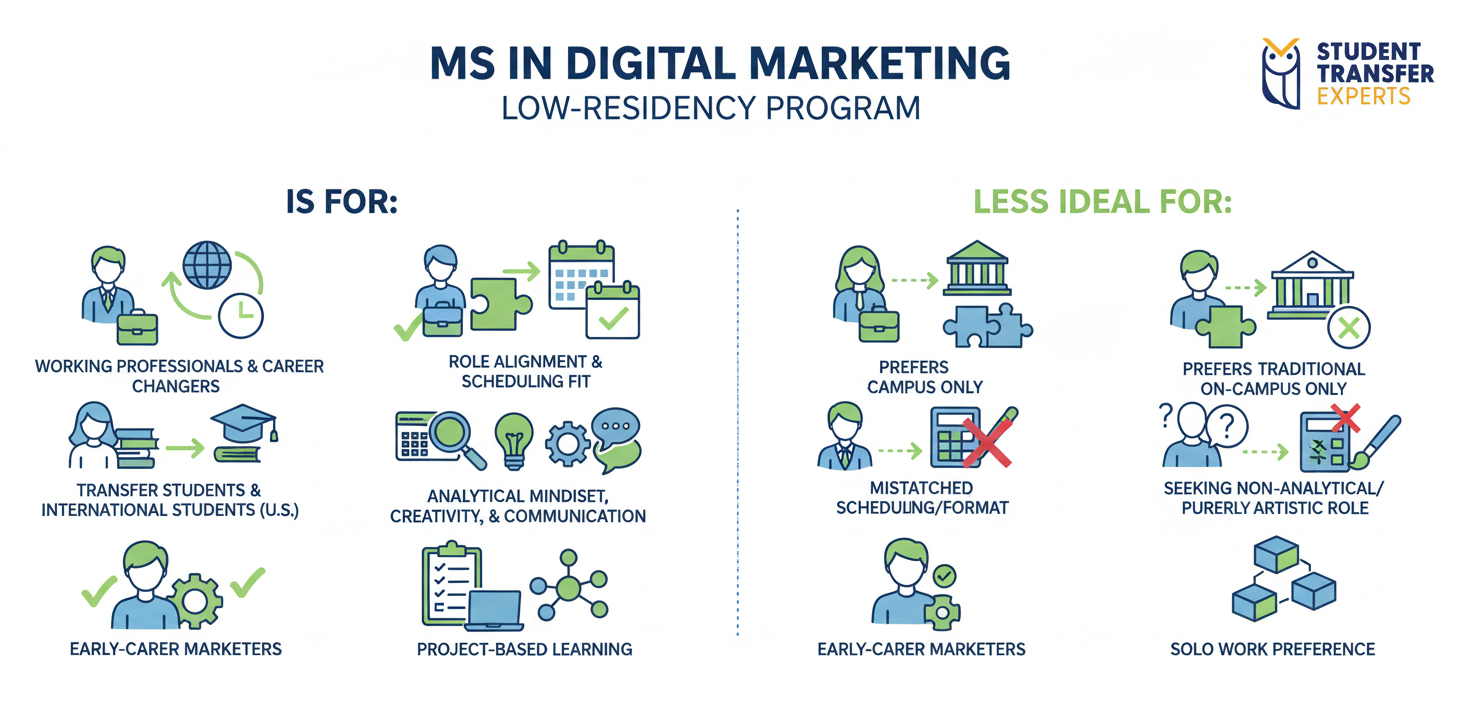
Infographic of Who the Low-Residency MS in Digital Marketing is for
A low-residency MS in Digital Marketing is often a strong fit for:
Best-fit learners
working professionals in marketing, communications, business, ecommerce, or sales support roles,
transfer students seeking a more career-aligned graduate pathway,
international students already in the US who need a structured but flexible format,
career changers with strengths in communication, analysis, and business thinking,
early-career professionals who want measurable digital skills rather than a purely generalist business degree.
Especially strong candidates
learners interested in performance-driven marketing,
students who want to combine creativity with analytics,
professionals who prefer project-based learning,
applicants who want skills that travel across industries.
Take the Next Step
If you're ready to evaluate your academic or professional pathway:
👉 Begin Your Application / Evaluation
https://form.typeform.com/to/HRz41hcQ
If you need clarity on: Transfers • Fresh admissions • STEM pathways • CPT/OPT • Low-residency formats • Career alignment
👉 Ask STE GPT your questions first
https://gpt.studenttransferexperts.com/
If you are comparing programme structures, transfer credit options, or career-fit questions, tools like TransferGPT and TransferBuddy can help you organize the decision process before you commit.
MS in Digital Marketing, low-residency, transfer students, workforce learning, digital marketing master’s, flexible learning, online education, career advancement, SEO, SEM, marketing analytics, social media marketing, ecommerce marketing, CPT, OPT
#MSInDigitalMarketing #DigitalMarketingMasters #LowResidencyEducation #TransferStudents #WorkforceLearning #FlexibleEducation #CareerAdvancement #MarketingAnalytics #SEO #SEM #SocialMediaMarketing #EcommerceMarketing #OnlineEducation #HigherEducation #StudentTransferExperts #TransferGPT