Professional Master’s in Public Health Low-Residency Programmes for Workforce Learning and Transfer Students
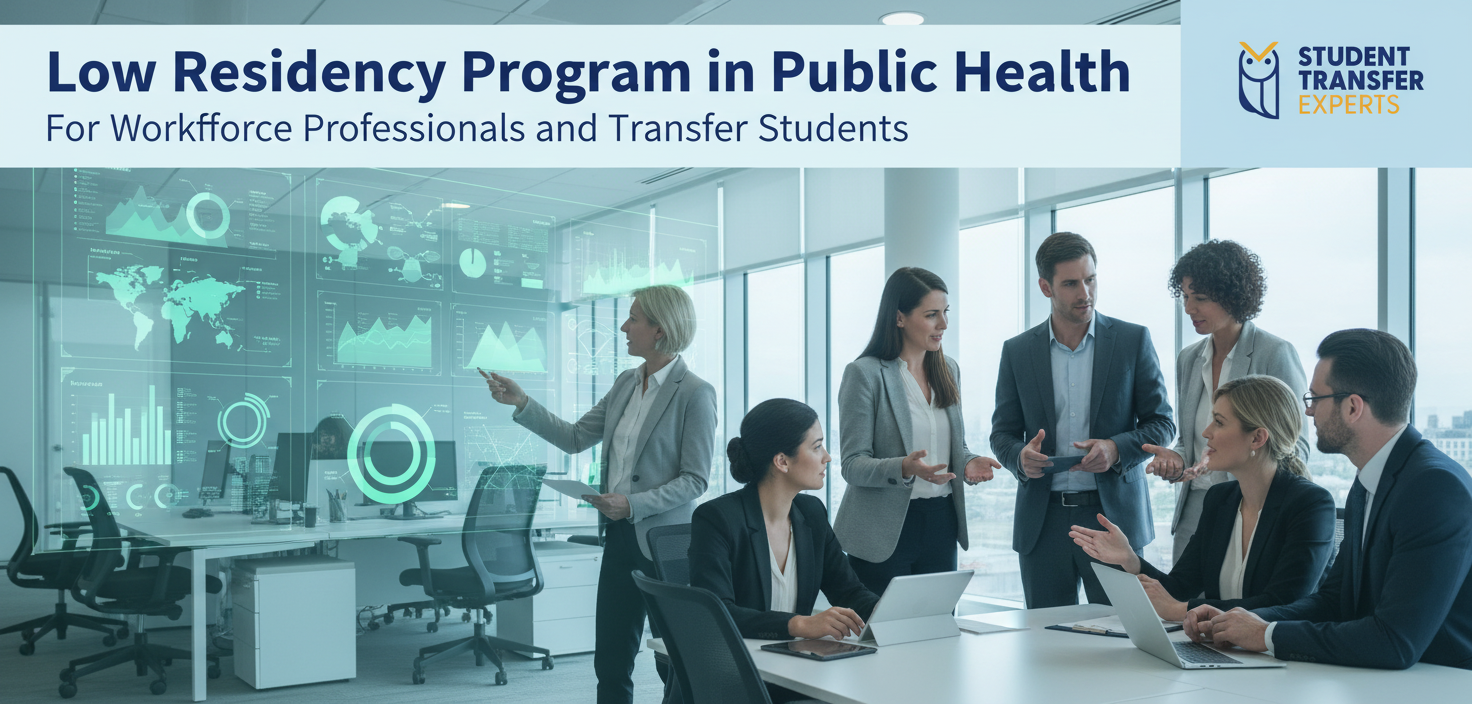
Blog Title Image
Introduction: Why Low-Residency Professional Master’s in Public Health Programmes Matter
A Professional Master’s in Public Health is distinct from a purely research-oriented graduate degree because it is built to prepare learners for applied public health practice, leadership, programme delivery, community partnership, and policy implementation. In practical terms, that means the degree is designed for people who want to improve health outcomes across populations, not just study them from a distance. It connects epidemiology, health systems, prevention strategy, community engagement, leadership, communication, and data-informed decision-making.
That distinction matters for workforce learners. Public health is not a field where knowledge stays inside the classroom. It is used in hospitals, health departments, nonprofits, advocacy organisations, health systems, insurers, schools, global health initiatives, and community-based programmes. A professional public health master’s degree works best when learners can keep one foot in practice while building new skills.
This is exactly why the low-residency model is such a strong fit. A low-residency structure allows students to complete substantial coursework flexibly while attending periodic on-site sessions for high-value activities such as applied workshops, simulation, leadership intensives, team problem-solving, and faculty-guided practice integration. For transfer students and working professionals already studying or living in the US, that structure can support continuity, affordability, career progression, and practical learning without requiring a fully campus-based lifestyle.
Research on MPH education in the US increasingly shows that these programmes are focused on workforce-defined competencies, leadership, applied practice, and transferable skills, rather than narrow academic specialisation alone. Public health employers are also looking for professionals who can combine data, communication, equity awareness, programme management, and community collaboration.
Understanding the Programme: Professional Master’s in Public Health
A Professional Master’s in Public Health prepares learners for roles that sit at the intersection of population health, systems improvement, prevention, and public service. Unlike a heavily research-driven route, a professional public health programme is typically oriented toward action: how to design interventions, interpret data, evaluate programmes, communicate risk, support policy, and improve health at scale.
Today’s public health environment is broader than many students first assume. It includes:
health promotion and prevention
programme management
health policy and advocacy
epidemiology-informed decision-making
community health partnerships
health equity strategy
environmental and occupational health awareness
emergency preparedness and response
cross-sector collaboration with healthcare, education, and nonprofit systems
A strong public health master’s programme also reflects what the Public Health Foundation’s Core Competencies for Public Health Professionals emphasise: broad knowledge and cross-cutting skills for practice, education, and research, organised around workforce needs. Those competencies are used by agencies and academic institutions to guide workforce development, improve performance, and strengthen community health outcomes.
Research published in Public Health Reports found that most MPH programmes in the US now explicitly focus on preparing graduates for public health practice, with emphasis on competence development, workforce readiness, leadership, collaboration, and applied problem-solving. That is important for learners considering low-residency study, because it confirms that public health education is increasingly aligned with practical employment outcomes.
The Public Health Industry Landscape
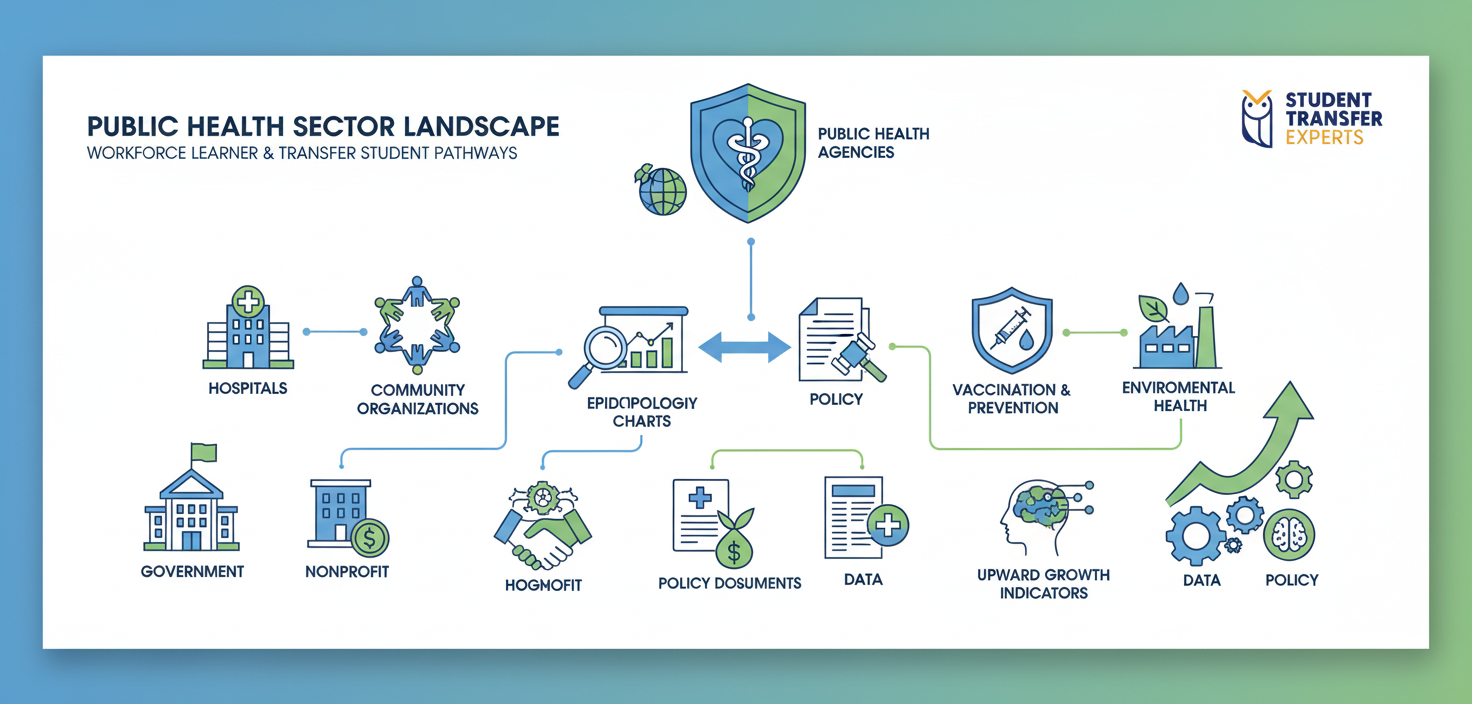
Infographic of the Public Health Industry Landscape
The public health industry is large, interdisciplinary, and still evolving. A Professional Master’s in Public Health can support movement into or upward within sectors such as:
governmental public health agencies
healthcare systems and hospitals
community and nonprofit organizations
health policy organizations
consulting and programme evaluation teams
insurers and population health divisions
academic medical centres
philanthropy and global health initiatives
health technology and analytics-adjacent roles
Current public health workforce research shows an important pattern: many graduates work outside government, often in healthcare organisations, nonprofits, and for-profit settings, even though government agencies continue to face major staffing needs. That tells prospective students something useful: the degree has cross-sector mobility. It is not limited to one employer type.
At the same time, the workforce conversation is changing. Recent evidence suggests that employers increasingly value professionals who can do more than understand theory. They want people who can:
translate data into action
work across agencies and sectors
communicate clearly with diverse audiences
lead teams and programmes
apply health equity frameworks
operate in fast-moving, community-facing environments
Recent public health reporting and industry coverage also point to rising demand in analytics, preparedness, community health infrastructure, and applied public health operations. In other words, public health is becoming more strategic, more interdisciplinary, and more implementation-focused.
For students, that means the field rewards those who can combine technical literacy with applied leadership.
Why Low-Residency Works Especially Well for Public Health
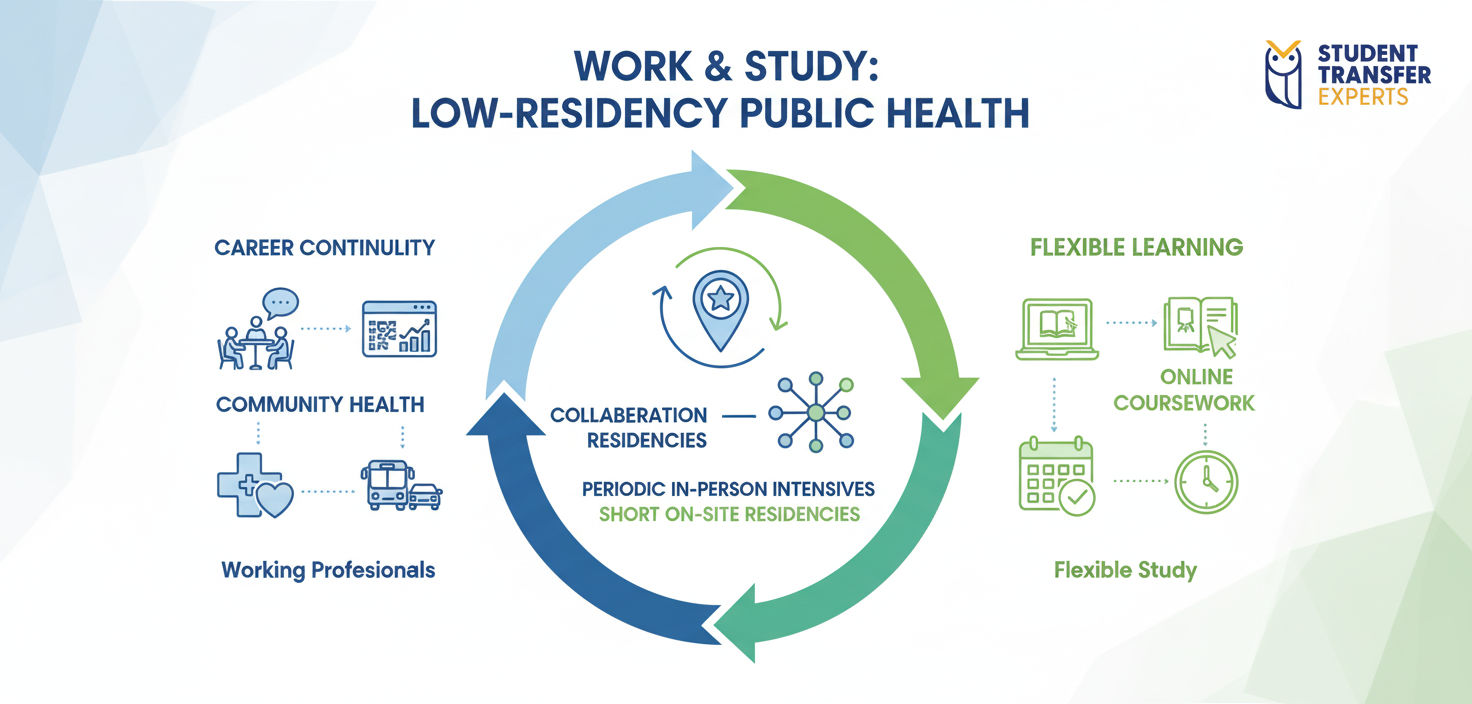
Infographic of Benefits of Low Residency Master’s in Public Health
Low-residency study fits public health particularly well because public health itself is a practice-connected discipline. Much of what students need to learn is best reinforced through a mix of flexible coursework and short, focused in-person experiences.
In a public health context, those periodic on-site sessions can be especially valuable for:
case-based team analysis
leadership labs
stakeholder communication exercises
programme design workshops
policy simulation
community strategy sessions
capstone collaboration
faculty mentoring and peer networking
For a working professional, that design is far more realistic than relocating for a full-time campus programme. It allows learners to remain employed in healthcare, nonprofits, education, or public service while directly applying what they learn to real settings.
For transfer students, low-residency can also reduce disruption. Instead of rebuilding life around a traditional full-time structure, students may be able to continue academic progress more strategically, particularly when working with our university partners on transfer evaluation, course alignment, and pathway planning.
The format is also helpful because public health careers often reward continuity of experience. Staying engaged in community-facing work while studying can make classroom learning more meaningful and career positioning stronger.
Comparison of Flexible Programme Structures
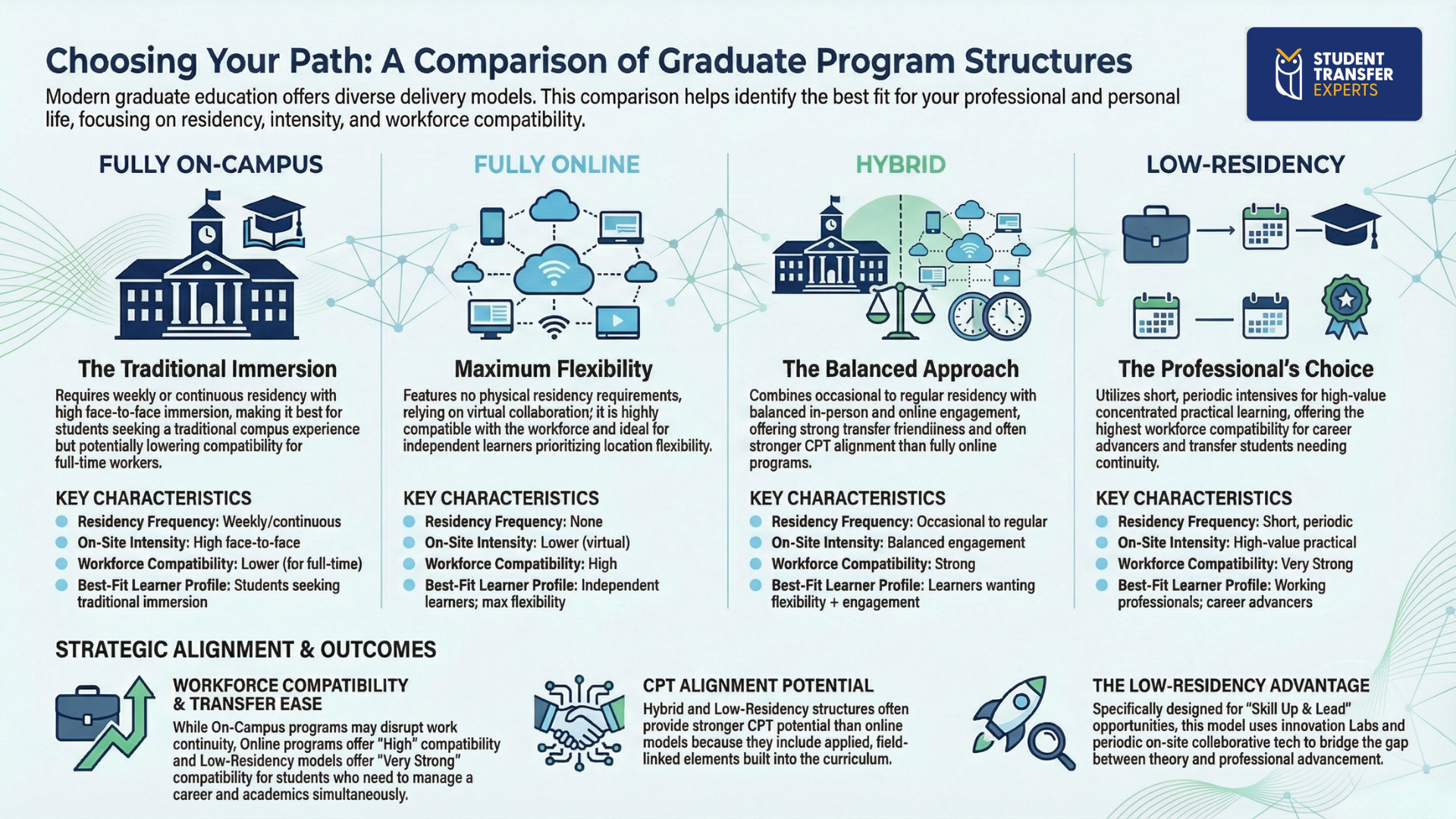
Infographic of Comparison of Flexible Programme Structures
For public health, the low-residency format often stands out because it preserves what matters most: flexibility, workforce continuity, and enough in-person structure to support applied learning. In a field built on collaboration, systems thinking, and real-world implementation, short intensive residencies can add value without requiring a fully residential commitment.
Curriculum & Skills: What Learners Actually Build
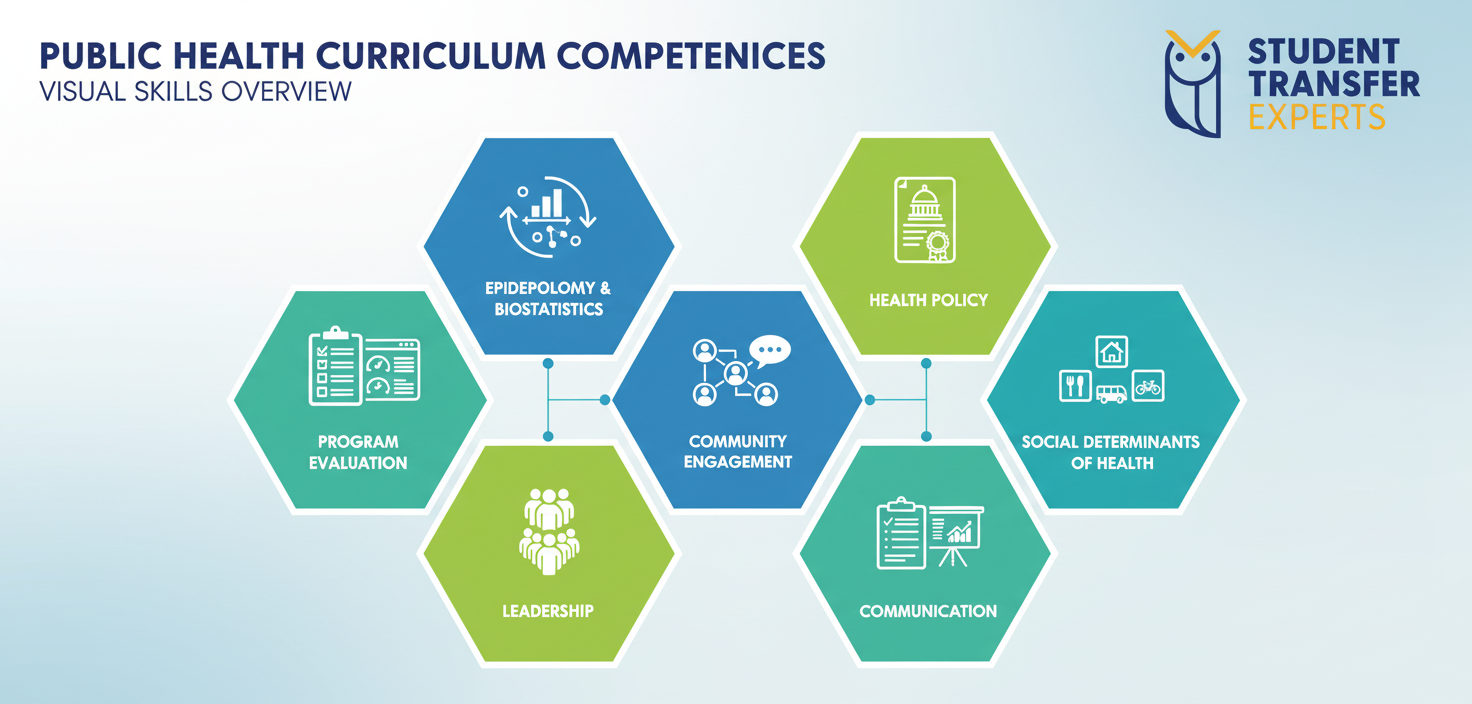
Infographic of Master’s in Public Health Curriculum
A Professional Master’s in Public Health usually builds a portfolio of competencies rather than a single, narrow technical identity. Based on current workforce and programme research, learners often develop skills in areas such as:
Core public health knowledge
epidemiology foundations
biostatistics and data interpretation
environmental and social determinants of health
health systems and policy
prevention frameworks
Applied workforce skills
programme planning and implementation
monitoring and evaluation
dashboard and report interpretation
evidence-based communication
policy memo and briefing development
partnership building across sectors
quality improvement thinking
Leadership and strategic skills
systems thinking
change management
team collaboration
community engagement
cultural responsiveness
health equity framing
stakeholder communication
A major takeaway from the research is that modern public health master’s education is not only about technical knowledge. It increasingly emphasises transferable, marketable, and adaptable skills. These include writing, data use, communication, leadership, collaboration, and the ability to operate in emerging areas of need.
That is especially useful for workforce learners because public health careers are often nonlinear. Someone may begin in community outreach, move into programme operations, then step into policy, compliance, analytics support, or health system strategy. A professional master’s degree in public health supports that kind of movement.
How Industry Values These Skills
Employers across public health-related sectors consistently value applied competence over abstract theory alone. That does not mean theory is unimportant. It means employers want graduates who can apply their knowledge in real-world settings.
In practice, organizations look for people who can:
interpret data without losing the human story
communicate with both technical and non-technical audiences
work in multidisciplinary teams
support programme decisions using evidence
respond to regulatory, equity, and community needs
manage projects and partnerships
think strategically under changing conditions
Relevant organisations include public health departments, hospital population-health teams, NGOs, community health organisations, advocacy groups, preparedness networks, research-to-practice initiatives, and public-serving foundations.
This is also why low-residency learning matters. Applied learning tends to be more credible to employers when students can demonstrate they have already used course concepts in their workplace, field setting, or professional environment.
Value for Transfer Students
A low-residency Professional Master’s in Public Health can be particularly useful for transfer students already in the US because it supports both academic continuity and career alignment.
CPT/OPT relevance for public health roles
Public health is a field with clear links to applied practice, which can make it relevant to CPT/OPT planning when a programme includes appropriate experiential or field-based components and when the role is directly related to the degree. Potentially relevant areas may include community health, health education, programme coordination, population health operations, research support, public health analysis, and nonprofit health initiatives. Exact eligibility depends on programme structure and institutional policy, so students should always verify details through official channels.
CGPA and credit transfer flexibility
Transfer learners often worry that graduate progression will become harder after changing institutions or pathways. In practice, outcomes depend on transcript strength, prior coursework, programme fit, and partner policies. Through our university partners, students may find more flexible pathways than they expect, especially when they pursue a thoughtful evaluation early and map prior academic work strategically.
On-campus residency requirements and practical learning benefits
For public health students, residency is not just a logistical requirement. It can be a learning advantage. Short in-person intensives often support activities that are difficult to replicate fully online, such as collaborative intervention design, leadership exercises, faculty advising, and peer networking.
Cost advantages of partner programmes
Without discussing specific figures, low-residency pathways can sometimes offer a more efficient overall study model for transfer students by reducing full-time relocation pressure, supporting continued work, and preserving academic momentum.
Visa and immigration process guidance
Students should treat visa and immigration decisions carefully and seek official guidance where appropriate. That said, programme format, academic load, on-site requirements, and field/practical components all matter in planning. This is one reason early advising is so important. Transfer students should evaluate programme design before committing, especially where residency expectations and work authorisation questions intersect.
Because STE focuses on transfer continuity and pathway clarity, tools like TransferGPT and TransferBuddy can help students organise questions around transfer credits, format fit, academic planning, and next-step decision-making before they submit applications.
Who This Programme Is For
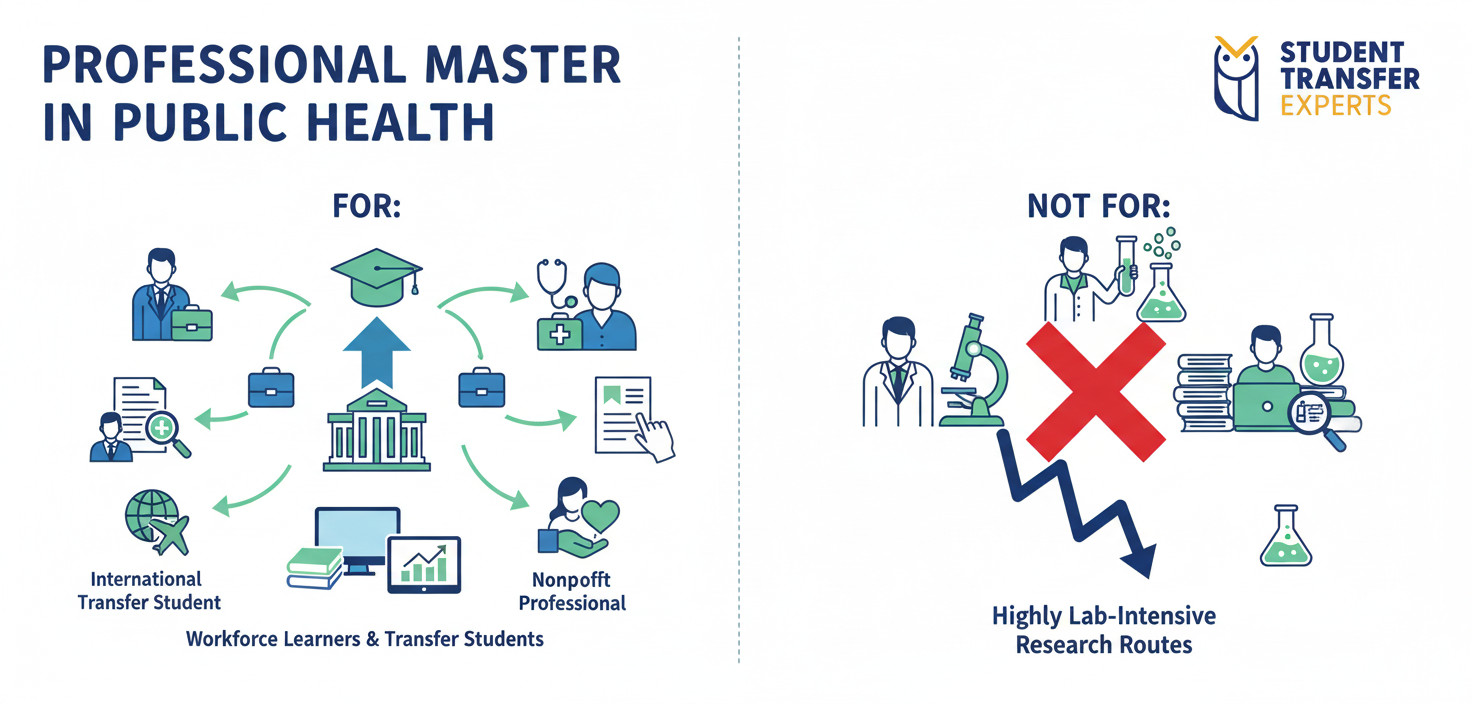
Infograohic of Who the Master’s in Public Health is for
A low-residency Professional Master’s in Public Health is often a strong fit for:
working professionals in healthcare, nonprofits, social services, education, or public service
transfer students already studying in the US who need continuity
career advancers seeking leadership, programme, or policy-oriented growth
international students looking for a flexible but structured format
learners interested in population health rather than only clinical care
professionals wanting to combine work experience with graduate education
In short, this programme is best for learners who want practical public health capability, flexible learning, and career mobility.
Take the Next Step
If you're ready to evaluate your academic or professional pathway:
👉 Begin Your Application / Evaluation
https://form.typeform.com/to/HRz41hcQ
If you need clarity on:
• Transfers
• Fresh admissions
• STEM pathways
• CPT/OPT
• Low-residency formats
• Career alignment
👉 Ask STE GPT your questions first
https://gpt.studenttransferexperts.com/
#ProfessionalMastersInPublicHealth #PublicHealth #LowResidencyEducation #TransferStudents #WorkforceLearning #FlexibleEducation #CareerAdvancement #OnlineEducation #PublicHealthCareers #PopulationHealth #HealthPolicy #CommunityHealth #StudentTransferExperts #TransferGPT