How a Low-Residency MS in Artificial Intelligence Supports Workforce Learning and Transfer Continuity
Blog Title Image
Introduction: Why Low-Residency MS in Artificial Intelligence Programmes Matter
An MS in Artificial Intelligence sits at the intersection of computer science, machine learning, data systems, automation, and responsible technology use. It is not just a coding degree. A strong AI master’s programme prepares learners to design, evaluate, deploy, and manage intelligent systems in real-world settings where accuracy, ethics, scale, and business relevance all matter.
That is exactly why the low-residency format is especially compelling for this field.
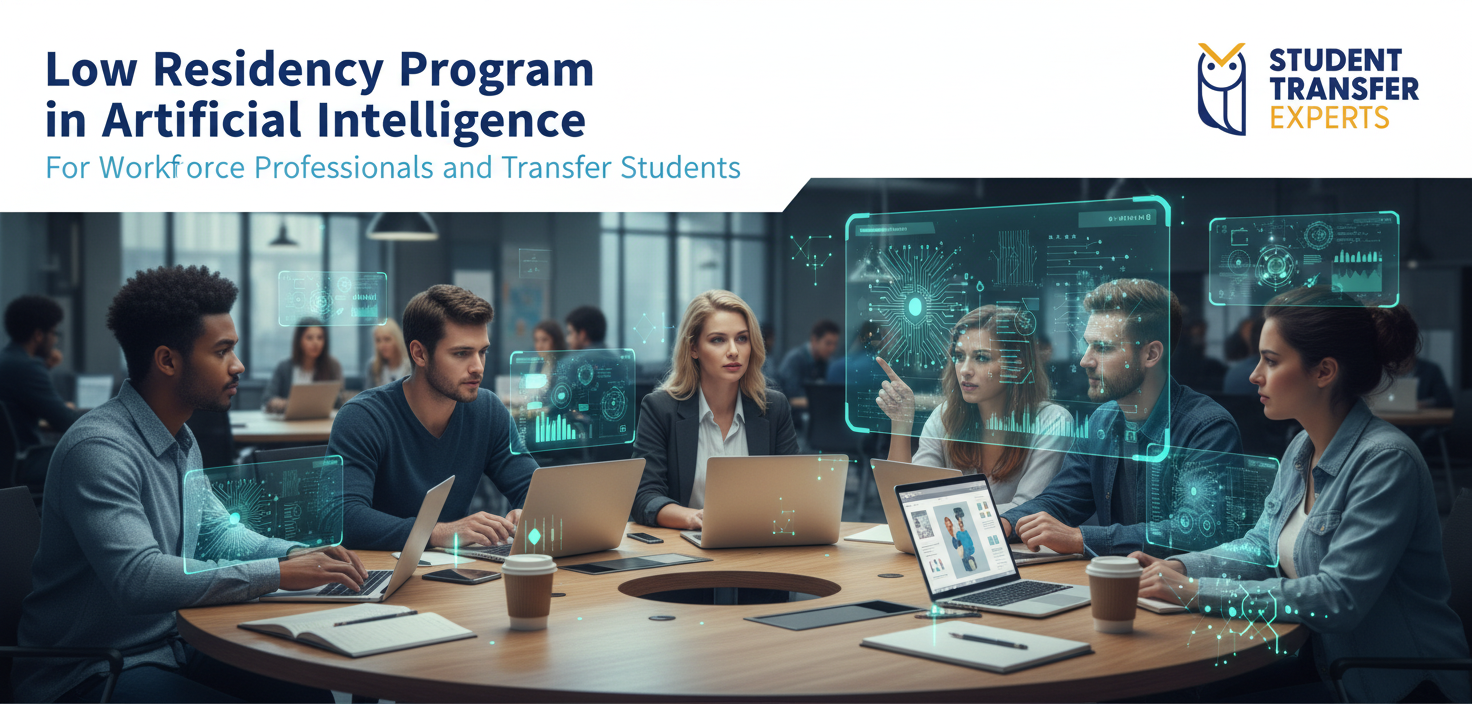
Artificial Intelligence evolves too quickly for many learners to pause work, relocate full time, or separate theory from application. Low-residency models create a more practical pathway: students complete substantial coursework remotely while attending periodic on-site sessions for labs, intensive workshops, collaboration, networking, or project-based learning. For transfer students and workforce learners already in the US, that combination can protect academic continuity while keeping professional momentum intact.
In AI, this matters because employers increasingly want more than isolated technical knowledge. They want professionals who can connect machine learning, data pipelines, governance, product thinking, and implementation. Recent workforce research also points to a widening gap between employer expectations and how higher education prepares graduates for AI-enabled work. That makes applied, flexible, and career-connected graduate study more valuable than ever.
Understanding the Programme: MS in Artificial Intelligence
A typical MS in Artificial Intelligence prepares learners for advanced work in areas such as:
machine learning
deep learning
natural language processing
computer vision
data engineering foundations
AI systems design
model evaluation
cloud-based deployment
responsible AI, policy, and governance
What distinguishes this programme from a general computer science degree is its applied concentration on intelligent systems. Instead of treating AI as a small specialization, the curriculum is built around AI methods, AI deployment, and AI decision-making contexts.
That can be particularly useful for learners coming from adjacent backgrounds such as:
computer science
software engineering
data analytics
information systems
mathematics
engineering
business technology roles
product or operations roles moving toward AI-enabled work
Some AI programmes lean heavily technical, focusing on algorithms, mathematics, and programming depth. Others are more interdisciplinary and include governance, policy, ethics, and sector-based applications. Research into current AI master’s structures shows that many programmes now blend both directions because industry increasingly values technical capability plus implementation judgment.
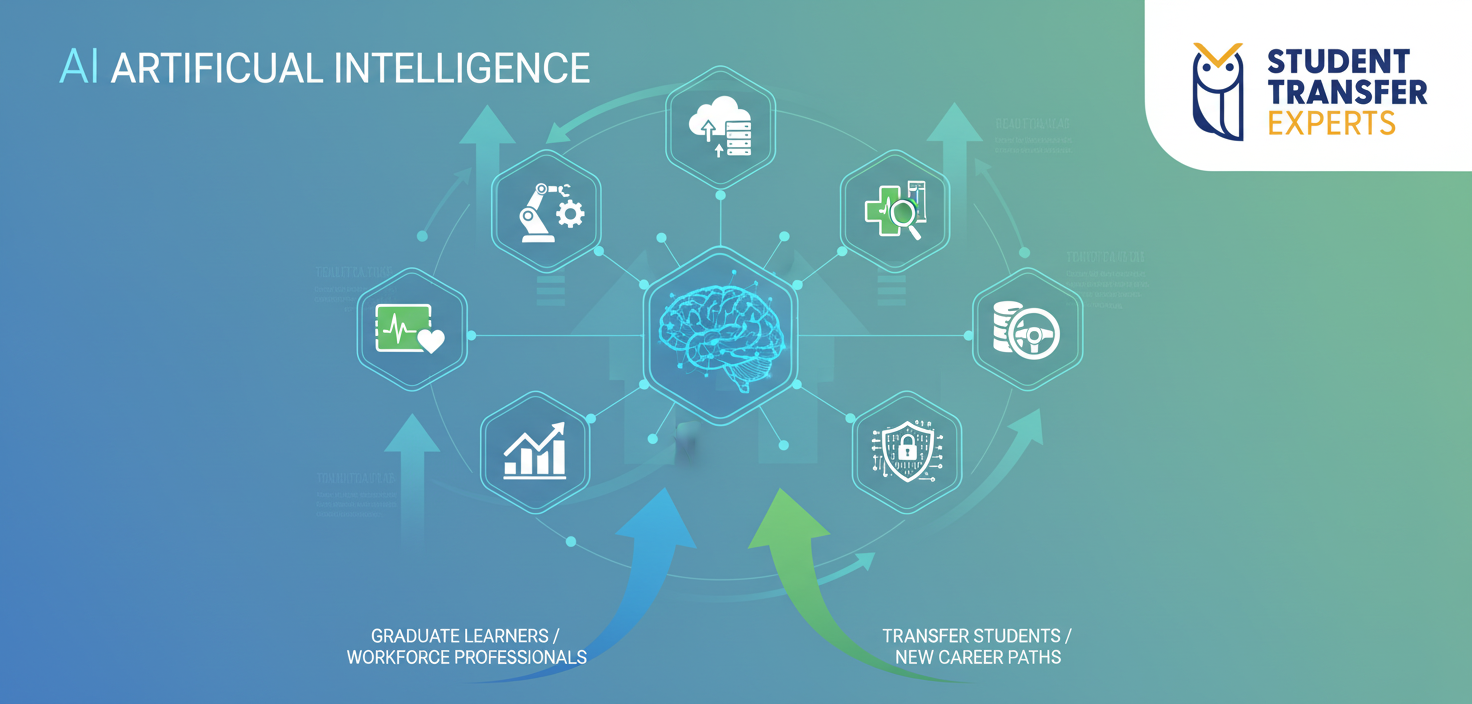
Why does this discipline matter now? Because AI is no longer isolated to research labs. It is shaping healthcare workflows, financial risk analysis, logistics, manufacturing, retail personalization, cybersecurity, enterprise automation, public-sector decision support, and product development. That means graduates are not only preparing for “AI jobs,” but for a much broader category of roles where AI fluency is becoming essential.
The Artificial Intelligence Industry Landscape
Infogrhic of the AI Industry Landscape
The AI industry is expanding beyond pure model building. Employers now need professionals who can work across the full lifecycle of AI adoption:
identifying business or operational use cases
preparing and governing data
selecting models and tools
evaluating performance
monitoring outputs
addressing compliance and risk
integrating AI into products and workflows
This shift is important for graduate learners. It means career opportunities are broader than titles like “machine learning engineer” alone.
Common employment sectors include:
technology and software
healthcare systems and digital health
finance and insurance
manufacturing and robotics
government and public-sector innovation
retail and e-commerce
education technology
logistics and supply-chain operations
consulting and enterprise transformation
Current research trends also show that responsible AI, governance, and evaluation are becoming core competencies, not optional extras. Recent reporting on employer demand suggests AI literacy is spreading quickly across college-level professions, while institutions are still catching up. Other workplace research highlights that governance and workforce training remain two of the biggest barriers to AI adoption. That creates a strong case for programmes that combine technical training with applied organizational understanding.
For students, the implication is clear: a competitive MS in Artificial Intelligence should help you build not only models, but judgment.
Why Low-Residency Works Especially Well for Artificial Intelligence
Infograpc of Benefits of Low-Residency Graduate Study
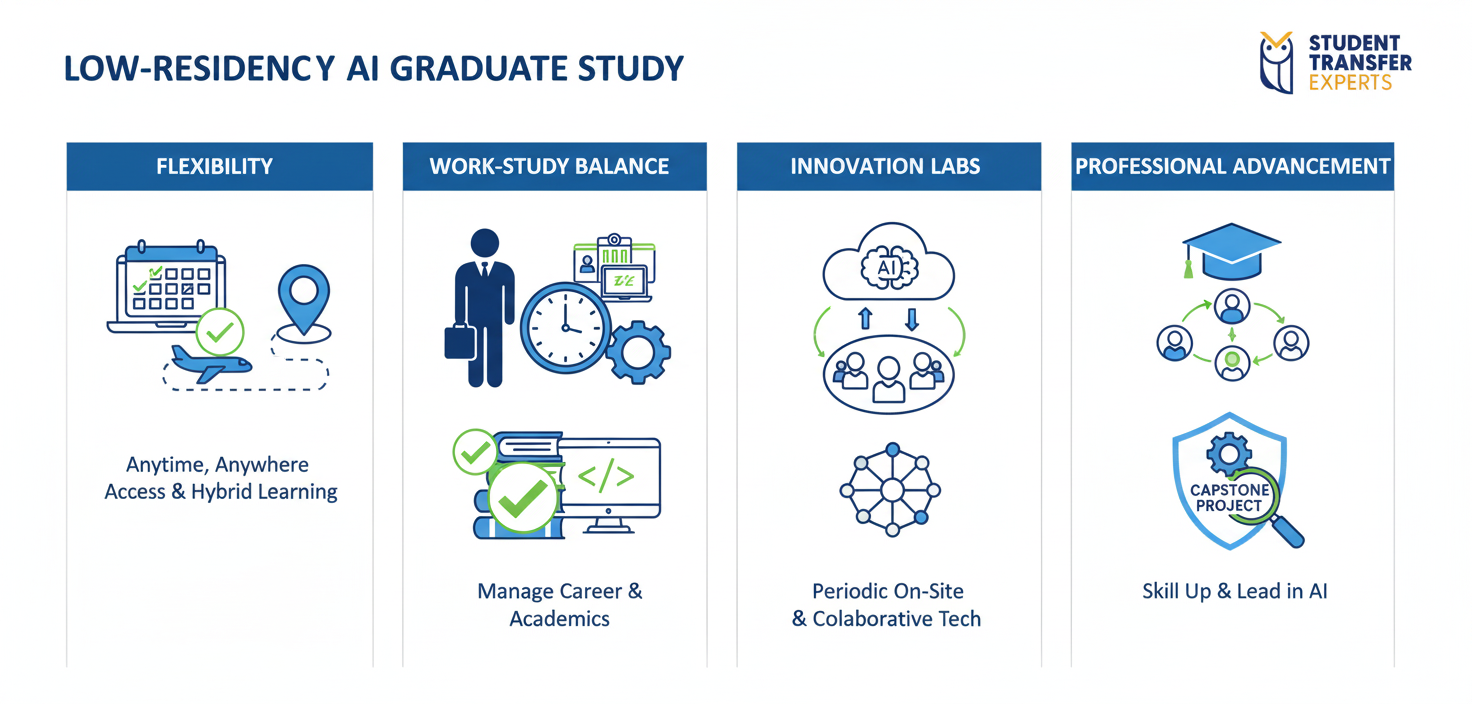
A low-residency MS in Artificial Intelligence aligns well with how AI professionals actually learn and work.
First, AI is highly project-based. Many skills are developed through iterative practice: coding, debugging, evaluating outputs, working with datasets, testing model performance, and presenting findings. Remote coursework supports ongoing learning, while periodic on-site residencies can add value through:
intensive labs
team-based prototyping
faculty feedback
capstone collaboration
networking with peers and industry-facing mentors
exposure to research or innovation environments
Second, many AI learners are already employed. They may be software developers, analysts, engineers, IT professionals, or career changers in adjacent digital roles. Low-residency formats allow them to continue working while applying new learning directly to professional settings.
Third, transfer students often need continuity, not disruption. A low-residency model can be more manageable than a fully campus-based structure because it reduces the need for immediate relocation while still preserving a meaningful academic community.
For workforce learners, the format also mirrors real industry conditions. AI teams increasingly collaborate across time zones, use cloud-based tools, and combine asynchronous development with periodic high-intensity teamwork. In that sense, low-residency learning is not just convenient; it can be professionally authentic.
Comparison of Flexible Programme Structures
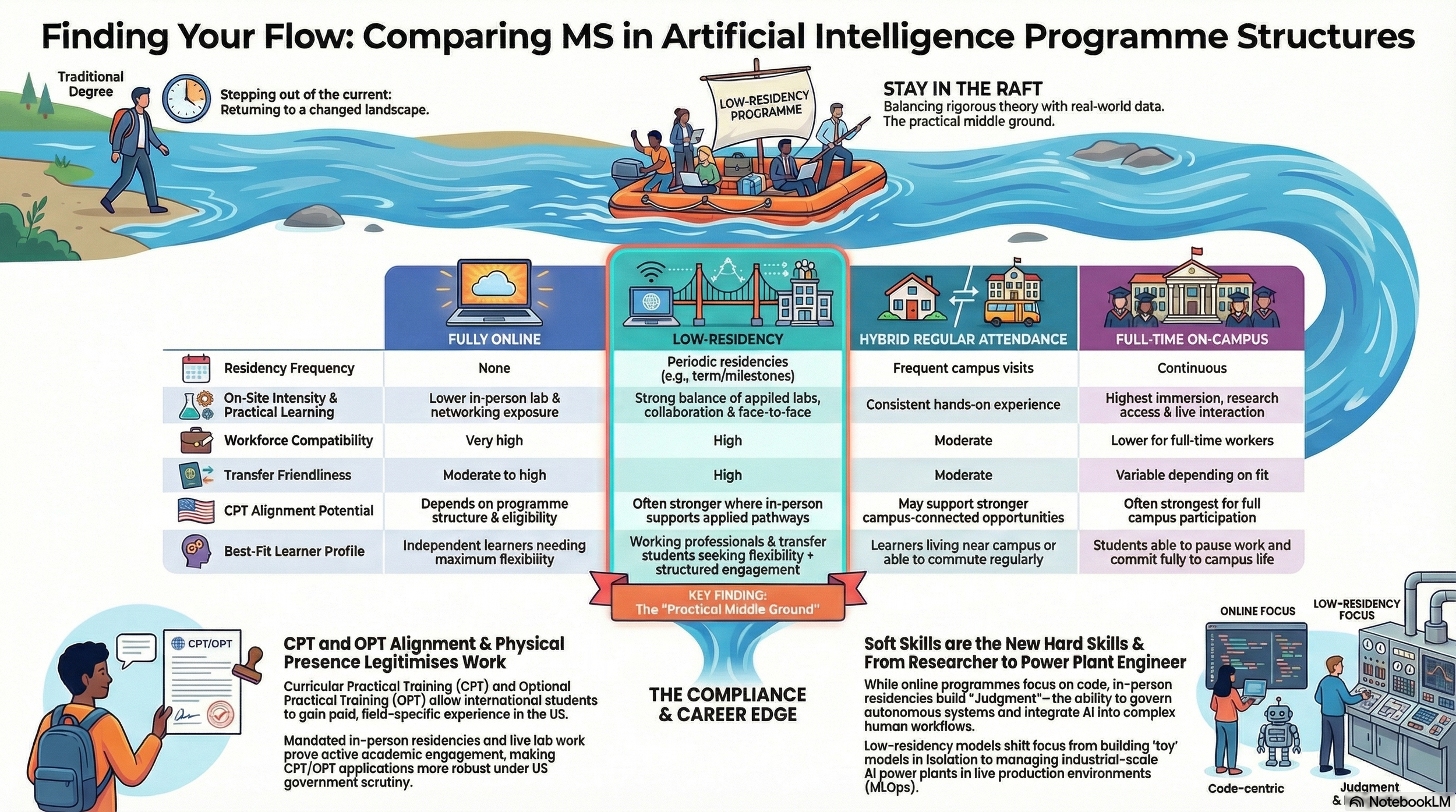
Infographic of Comparison of Different Program Structures
For Artificial Intelligence, low-residency often hits the practical middle ground. It gives students enough in-person engagement for project-based learning and relationship building, without requiring the full lifestyle reset of a traditional campus programme. That balance is especially useful for learners who need flexibility but do not want a purely isolated online experience.
Curriculum & Skills: What Learners Actually Build
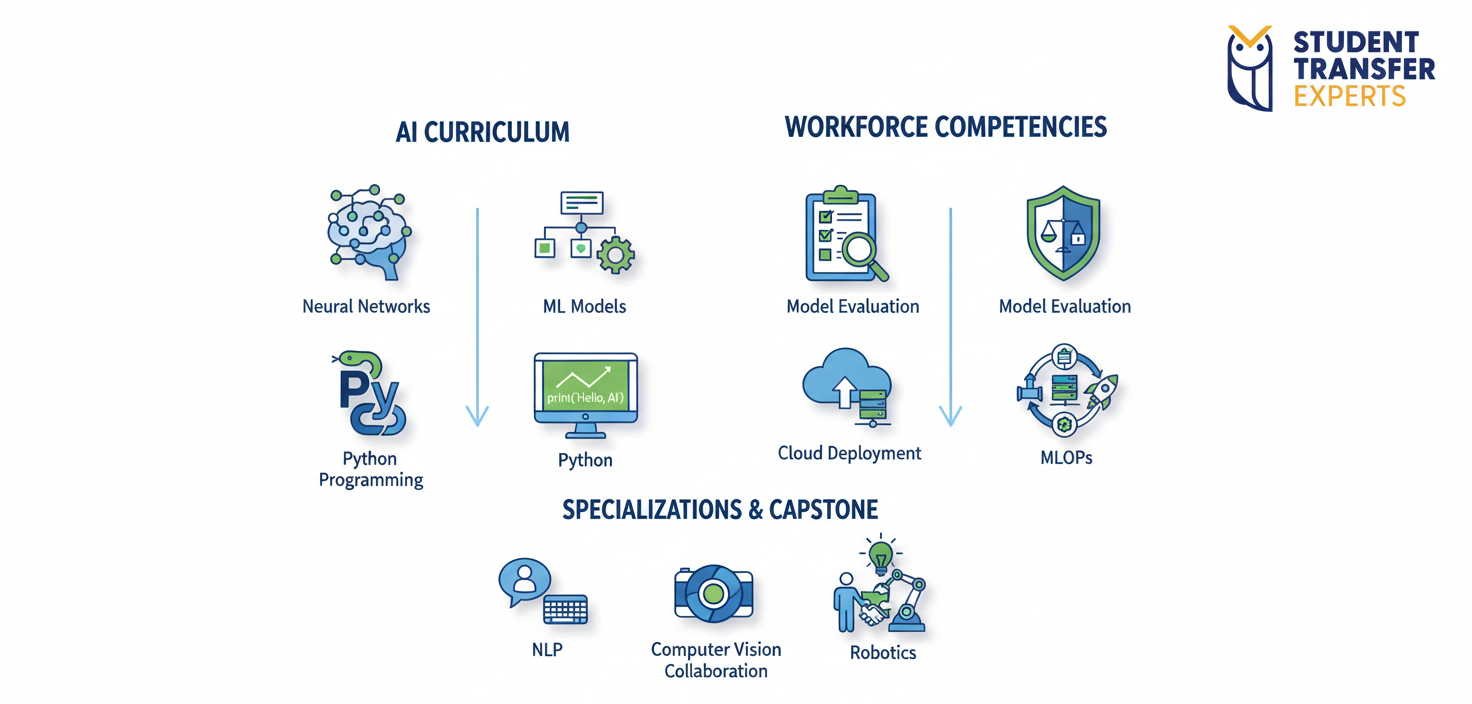
Infographic of AI Curriculum
A good MS in Artificial Intelligence should develop both technical and applied competencies.
Core technical skills
Students typically build strength in:
Python and AI-oriented programming workflows
statistics and probability for model building
linear algebra foundations
machine learning algorithms
deep learning architectures
natural language processing
computer vision
model training and tuning
data analysis and feature engineering
Applied systems skills
Industry increasingly values the ability to move beyond notebooks and prototypes. That includes:
model evaluation and validation
data quality awareness
MLOps and deployment thinking
cloud-based AI workflows
experiment tracking
cross-functional collaboration
translating technical outputs for business or operational stakeholders
Responsible AI and governance
This is a major differentiator. Current programme trends show increasing emphasis on:
AI ethics
governance frameworks
policy and compliance awareness
risk assessment
bias detection and mitigation
explainability
societal impact
Workforce-relevant learning method
Many strong AI programmes now include:
capstones
interdisciplinary projects
case-based analysis
domain application work
stackable certificates or modular progression
portfolio-oriented assignments
For transfer learners, these structures can be especially helpful because they create more visible evidence of learning, which matters when connecting education to internships, practical experience, or career pivots.
How Industry Values These Skills
Employers across AI-related roles typically value professionals who can do three things well
Understand the technical foundations
Apply AI to realistic operational problems
Use AI responsibly and communicate its limits clearly
This is why applied learning matters. Industry often prefers graduates who can demonstrate workflow competence, project execution, and cross-functional communication over learners who only know theory in isolation.
Relevant employers and organizations may include:
software and platform companies
enterprise technology teams
consulting firms
health systems
financial institutions
robotics and manufacturing organizations
public agencies using AI for planning or operations
nonprofits and mission-driven technology groups
In practical terms, AI graduates may move into roles such as:
machine learning engineer
AI engineer
data scientist
applied scientist
product analyst or AI product specialist
AI solutions consultant
analytics engineer
intelligent systems developer
AI governance or model risk support roles
The strongest career growth often comes when students can connect AI methods to sector knowledge. That is another reason low-residency can be effective: working learners can test concepts in live environments while studying.
Value for Transfer Students
Transfer students evaluating a low-residency MS in Artificial Intelligence should focus on pathway design, not just programme marketing.
CPT/OPT relevance for AI roles
AI is generally aligned with fields where practical training can be highly relevant, especially in data, software, analytics, engineering, and intelligent systems roles. Depending on programme design, institutional policies, and a student’s immigration status, CPT and later OPT may be important considerations for gaining field-related experience.
However, CPT/OPT eligibility depends on the institution, programme structure, timing, and personal immigration circumstances. Students should treat this as an academic and compliance planning issue, not a last-minute question. STE advises students to review programme structure early and confirm how practical learning opportunities connect to field-of-study requirements.
CGPA and credit transfer flexibility
Graduate AI pathways can vary significantly in admissions expectations. External programme research shows that a 3.0 GPA benchmark is common, but not every pathway evaluates applicants identically. Our university partners may offer different levels of flexibility depending on prior coursework, technical preparation, and overall profile strength.
For transfer students, the bigger issue is often not just GPA, but academic fit:
prior coding preparation
math readiness
relevant undergraduate coursework
transferable graduate credits, where applicable
evidence of technical or professional experience
Credit transfer patterns and optimization
AI programmes are usually less flexible than broad general studies programmes because course sequencing matters. Foundational subjects such as programming, linear algebra, probability, algorithms, and data methods often affect what can transfer smoothly. Even so, students may still be able to optimize their path through:
prior relevant graduate coursework
stackable certificate structures
bridge courses
evaluated transfer credits where permitted
aligned prerequisite planning before enrolment
On-campus residency requirements
In AI, on-campus or short-residency components can have genuine academic value. They may support:
lab-based collaboration
capstone planning
peer networking
faculty access
technical workshops
innovation and research exposure
For transfer students, this can make the programme feel more connected and professionally useful than a fully remote experience.
Cost advantages and visa-process guidance
Our university partners may offer relative cost advantages compared with higher-cost traditional pathways, especially when students can preserve work continuity, reduce relocation demands, or build a more efficient academic sequence. On immigration and visa matters, students should seek accurate school-based guidance and qualified professional advice where needed. STE can help students understand pathway options and administrative questions, but does not provide legal advice.
How STE tools can help
If you are comparing AI pathways, TransferGPT can help you ask better questions about transferability, programme fit, low-residency formats, STEM alignment, and readiness. TransferBuddy support can also help students organize documents, evaluate progression options, and think more strategically about continuity.
Who This Programme Is For
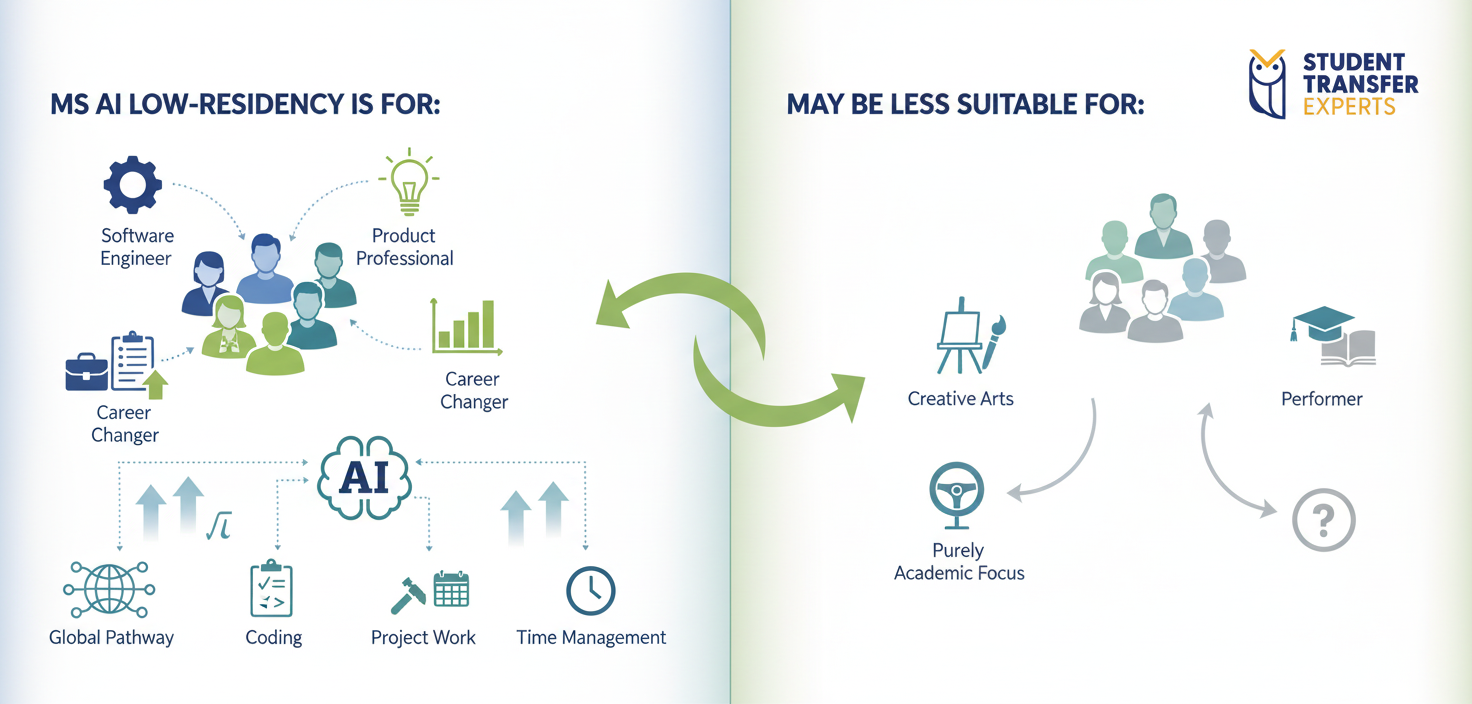
Infgraphic of Who This Course is For
A low-residency MS in Artificial Intelligence is often a strong fit for:
working professionals in software, analytics, IT, or engineering
transfer students already in the US seeking academic continuity
professionals who need flexibility but still want periodic in-person engagement
learners aiming to move from data or technical support roles into AI-focused roles
career changers with real quantitative readiness and motivation
students interested in both technical AI and responsible implementation
For some students, a related pathway like computer science, data science, analytics, or information systems may be the better first step before specializing more deeply in AI.
Take the Next Step
If you're ready to evaluate your academic or professional pathway:
👉 Begin Your Application / Evaluation
https://form.typeform.com/to/HRz41hcQ
If you need clarity on: • Transfers • Fresh admissions • STEM pathways • CPT/OPT • Low-residency formats • Career alignment
👉 Ask STE GPT your questions first
https://gpt.studenttransferexperts.com/
MS in Artificial Intelligence, low-residency, transfer students, workforce learning, online education, flexible learning, career advancement, AI master’s degree, artificial intelligence graduate programme, STEM transfer pathway, CPT OPT AI, AI skills for working professionals